Which Properties Are Eligible to Receive ICAP Tax Benefits?

ICAP abates the property tax increase that new construction, renovation or expansion creates on eligible commercial and industrial buildings, for 8 to 25 years.
ICAP cuts NYC property tax on eligible commercial and industrial buildings for up to 25 years. Preliminary applications are accepted until March 1, 2029, and the application must be filed on or before the day the first building permit is issued. Eligibility turns on where the property is, how it is used, and whether the project spends at least 30 percent of the property’s taxable assessed value within four years of that permit. Our free tool walks through each of those in turn: what ICAP actually does, who qualifies, and how the filings run.
Update, August 2026: preliminary applications are accepted until March 1, 2029, and no benefits are granted where the first construction permit issues after April 1, 2029. Chapter 332 of the Laws of 2024 set those dates. The FY2026 state budget signed May 9, 2025 left them in place and narrowed the program instead: licensed parking facilities and consumer storage warehouses are now excluded, and Governors Island becomes a special commercial abatement area on January 1, 2026. For the filing itself, see our ICAP application and renewal service.
Our clients frequently ask whether their projects are eligible for New York City’s widely used Industrial & Commercial Abatement Program (ICAP). Although developers and property-owners have been utilizing ICAP (as well as its predecessor, ICIP) for a number of years, the question of project’s eligibility remains somewhat tricky to answer. In this post we’ll discuss several of the common questions around the program and project eligibility, and how to learn more for your own project.
The Overview of ICAP Tax Benefits
ICAP provides property tax abatement on certain industrial and commercial building projects for up to 25 years. To be eligible for ICAP, property owners and developers should be aware of certain initial qualifiers before applying, such as the project’s geographic location, amount of expenditures, completion timeline, and types of eligible construction or improvements. MGNY has a deep understanding of all ICAP requirements and regularly advises clients on the most effective way to meet them.
Geographic Limitations
- Locations in the City – Commercial work in Manhattan south of 96th Street is subject to the statutory exclusion and renovation-area rules. Renovation work may qualify in the designated areas south of 59th Street, Lower Manhattan and the Special Garment Center District. New commercial construction in renovation areas is generally excluded, subject to the narrow Lower Manhattan exception. Governor’s Island is a special commercial abatement area from January 1, 2026; confirm the exact parcel and project classification. See RPTL 489-gggggg(2)-(5).
- Special Areas – each of the five boroughs contains a range of blocks that are in the so-called special area, allowing for 25-year benefits for particular project types.
Requirements for ICAP Tax Benefits
The major requirements for the program include:
- Minimum Required Expenditure (MRE) – For a project to be eligible, an MRE of at least 30% of the property’s Taxable Assessed Value must be spent no more than four years from the date of the first permit for your project. For industrial projects, additional benefits kick in if at least 40% of the Taxable Assessed Value is spent in that time frame.
- Time Frame – Construction must be completed no later than five years from the first building permit, or commencement if no permit is required. Missing that deadline ends inflation protection for subsequent tax years; it is not a blanket cancellation of the underlying abatement. See RPTL 489-cccccc(2).
There are some additional limits to the program that developers should be aware of which apply to come into effect for certain types of projects. Examples include:
- Residential Considerations: ICAP does not cover residential construction work. Work on a structure or building is also excluded when 20% or more of the property’s total rentable square footage is or will be residential. Apply the statute’s tax-lot and condominium aggregation rules; see RPTL 489-cccccc(3)(a).
- Utilities are Generally Ineligible – Utility property is excluded. Electricity-generating peaking units are treated separately and may qualify under their specific ICAP rules. See RPTL 489-aaaaaa(17) and 489-bbbbbb(3)(b-1).
- Retail Space Allocation – There are different abatement schedules that may be applied depending on the percentage of space allocated for retail use (see benefit schedules below)
In addition to the above requirements, if the project reaches a certain monetary threshold, additional eligibility considerations apply, including promotion of contracting opportunities for minority- and women-owned business enterprises (M/WBE).
Want to test a specific project against these rules? Our free NYC ICAP eligibility check screens a property in about a minute, new construction or renovation, and names the minimum spend the project would have to meet.
While not all projects will meet the complex eligibility requirements described above, MGNY can advise property owners and developers on there are other options. For example, if the project is partially or fully in areas that are considered ineligible, there are other exemption and abatement programs to consider.
Benefit Schedule
- 8-year benefit – Commercial new construction projects south of Murray Street may qualify for an 8-year ICAP benefit, if buildings are constructed per SMART requirements. Full abatement above the base is granted for the first four years of the 8-year period; while years 5-8 are subject to a gradual phase-out of benefits.
- 10-year benefit – Renovation projects in Manhattan south of 59th Street and north of Murray Street (excluding Garment Center) qualify for a 10-year benefit. Retail space in excess of 5% of the floor area is not covered by the benefit. Full abatement above the base is granted for the first five years of the 10-year period; while years 6-10 are subject to a gradual phase-out of benefits.
- 12-year benefit – Eligible renovation projects in Lower Manhattan and the Special Garment Center District may receive a 12-year benefit. The exclusion for retail above 5% applies in the Garment Center, but does not apply to Lower Manhattan. See RPTL 489-bbbbbb(3)(d). Full abatement above the base is granted for the first eight years of the 12-year period; while years 9-12 are subject to a gradual phase-out of benefits.
- 15-year benefit – The 15-year benefit applies to qualifying commercial construction outside special commercial abatement and renovation areas. For industrial construction or commercial work in a special area with retail above 10%, only the excess retail receives the shorter schedule; the non-retail portion and first 10% of retail keep the 25-year schedule. See RPTL 489-bbbbbb(3)(a)-(c). Full abatement above the base is granted for the first eleven years of the 15-year period; while years 12-15 are subject to a gradual phase-out of benefits.
- 25-year benefit – The following project types qualify for the 25-year benefit:
-
- Industrial construction where not more than 10% of the floor area is used for retail purposes
- Eligible commercial construction in special areas, subject to the excess-retail split above 10%
-
Determining Eligibility for Your Project
Over the past decade, MGNY has worked closely with developers to determine whether a project is the right fit for the program. We help our clients through a three-step process that begins before the first permit is issued. Steps in a successful project include:
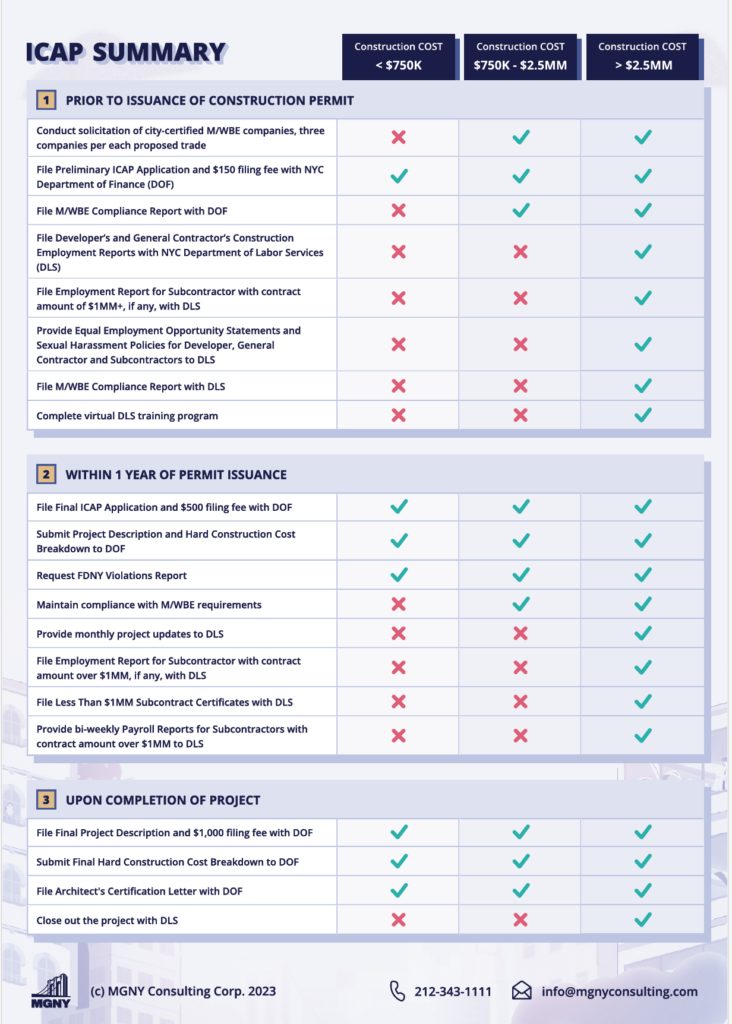
Additional requirements come into effect as the size of the project increases, with new requirements between $750,000-$2,500,000 and between $2,500,000-$50,000,000. Examples include solicitation of city-certified M/WBE companies, filing of employment reports with NYC Department of Small Business Services, attending pre-award conferences, and much more. Many of these additional steps are time-sensitive, thus it’s important to act immediately to take full advantage of the ICAP program.
Closing the Project
Upon completion of an ICAP eligible project, MGNY takes the following steps to meet the New York City’s requirements, including:
- Filing of notice of completion with NYC DOF, including a $1,000 filing fee.
- Filing of final narrative description of the project with NYC DOF.
- Filing of detailed itemized cost of construction, certified by a CPA.
- For larger projects, closing out the project with NYC Department of Small Business Services.
From start to finish, application for and completion of a project that benefits from ICAP tax abatement may take several years and has more than a dozen individual steps. For this reason, our clients have long trusted us to provide support in researching, applying for, and managing the process from start to finish.
To learn more about ICAP and whether your project is eligible for the program, use our ICAP eligibility checker below or contact us directly to discuss your options.
ICAP Eligibility Checker
Enter an NYC address to check ICAP eligibility in under 2 minutes. Free, no sign-up.
The same checker, with four short guides to the program, is at icapnyctax.com.
Is there a free ICAP eligibility checker?
Yes. MGNY’s ICAP Eligibility Checker at icapnyctax.com is free and needs no sign-up: enter a New York City address, answer three questions about the project, and in under two minutes it reads the city’s assessment roll and says whether the project appears eligible. It is a screen, not a determination; the Department of Finance decides eligibility on the application.
ICAP is one of several programs that reduce a NYC tax bill. The difference between an abatement and an exemption, and the programs that still exist in 2026, is covered in NYC tax abatements explained.
An ICAP abatement also has to be kept: the owner files a Certificate of Continuing Use every other year, and the 2027/28 certificates are due January 5, 2027. Our guides cover the January 5, 2027 deadline, the records to have ready, what follows a missed certificate and why ICAP renews every other year while ICIP renews every year.
Planning an ICAP project or renewing an existing benefit?
For a construction project, review ICAP application and filing support. For an existing abatement, see Certificate of Continuing Use renewals.
Use the ICAP eligibility checker for an initial screen, or call (212) 343-1111 with the property address, permit status and any renewal notice.
Our 2026 guide, What Is ICAP?, carries the current eligibility tests, the filing deadlines and the benefit schedule, which runs up to 25 years.
Get our updates first on Google. Deadlines move: ICAP applications now run to March 1, 2029, and this year’s surcharge exemption deadline moved twice before landing on October 6. Tap the button and Google adds MGNY Consulting to your preferred sources, so our coverage surfaces first in your results. No signup and no email, and one tap undoes it.