$40,000 in RPIE Penalties, $1,000 Left to Pay
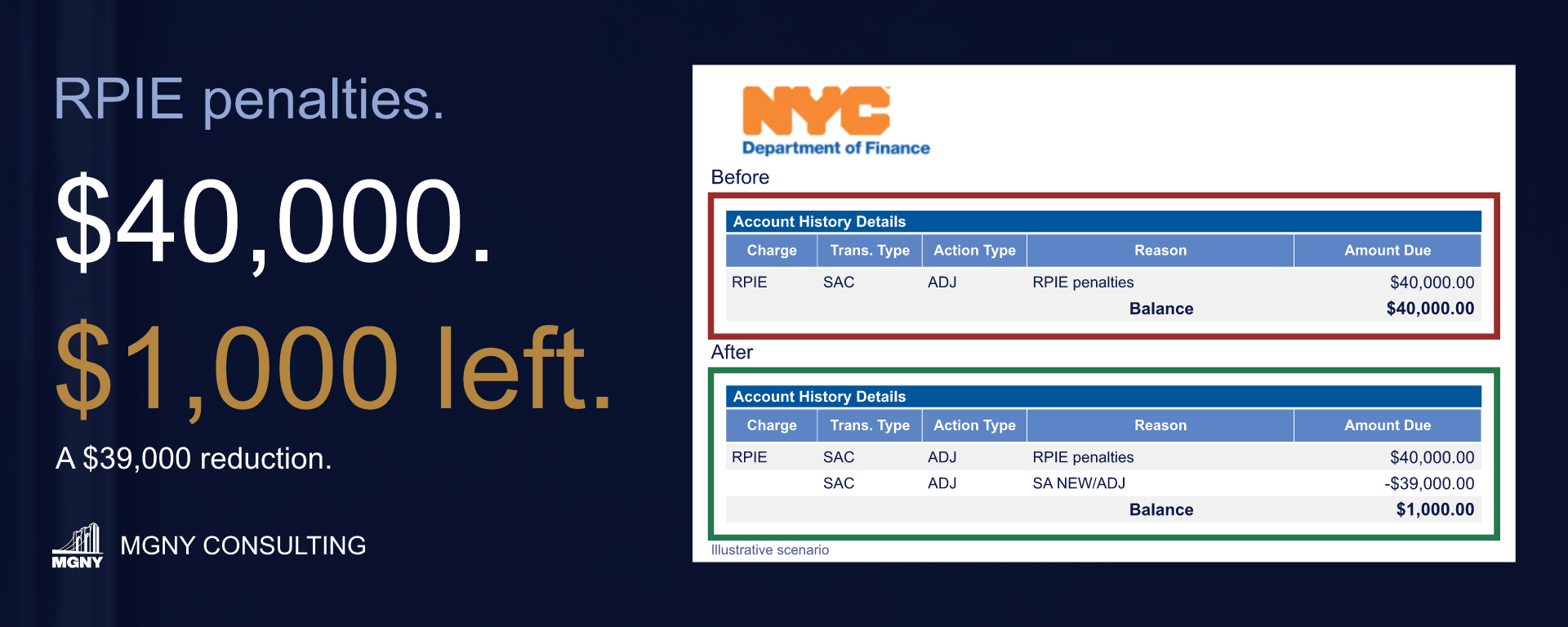
A client had $40,000 in RPIE non-filing penalty charges reduced by $39,000, to $1,000. Other penalties entered October 26 are expected on the next bill.
“I’m looking at the account right now,” my client said. “The $40,000 in penalties is down to $1,000.”
That was Monday, November 9. Two weeks earlier, the same account read very differently.
On October 26, the Department of Finance (DOF) had entered those penalties for RPIE, the annual Real Property Income and Expense statement. Miss the deadline, then the 30-day cure period that follows DOF’s notice, and a penalty goes on the account, from $300 to $100,000. None of that is personal. It’s a process, and it runs on the filings DOF has on record.
Can a penalty come off? Sometimes, and it isn’t easy. DOF’s guide speaks of “limited circumstances” and says “there is no exception for reasonable cause in the RPIE law”.
This one took a team. We pulled the whole account history, researched the rules against the property’s facts, and had a second person check all of it before we asked DOF to review.
DOF reviewed the account and reduced the penalties by $39,000. $1,000 stays. That’s what my client was looking at on that call.
Nobody can promise that result. DOF decides, and if no rule fits, the penalty stays.
One thing we didn’t do was wait for the mail. Penalties entered on October 26 are expected on the next quarterly statement, and we expect that statement around November 15. Look at your account before then.
The call is retold in my words, not quoted.
This story is illustrative. It’s based on results we’ve obtained for our clients and shows what a client can experience. Every account is different, and DOF decides each one.
What does it cost to ask MGNY?
Nothing. A real person answers at 212-343-1111, and the consultation is free. You engage us only if you want the work handled for you.
MGNY has worked NYC property tax since 2008, with nearly $300M in tax savings secured for owners, 900+ developments with tax abatements secured and $30B+ represented in appeals, and files 2,500+ RPIE statements a year.
Sources, all read November 9, 2026: the DOF RPIE penalty guide, the DOF rules for RPIE statements as amended in 2014, the DOF property tax bills page, and the NYC311 article on RPIE. MGNY Consulting is a property tax consultancy and is not affiliated with the Department of Finance.
Michael Geylik
Founder and President, MGNY Consulting
Frequently asked questions
What is the RPIE Non-Filing Penalty Charge on a property tax bill?
The RPIE Non-Filing Penalty Charge is the name NYC311 uses for an RPIE penalty that appears on a property tax bill or statement of account. The Department of Finance (DOF) assesses the penalty when a required Real Property Income and Expense (RPIE) statement is not filed by the deadline and not filed during the 30-day cure period after DOF’s Non-Compliance Notice, unless a petition was filed. No penalty is billed in a property’s first year in the requirement. For a missing RPIE statement, the amount is based on the DOF schedule, from $300 to $100,000 by final assessed value, and three consecutive years without a filing may bring a penalty of five percent of the final actual assessed value.
Does an RPIE penalty stay with a property after it is sold?
An RPIE penalty stays with the property after it is sold. NYC311 states that “RPIE penalties and interest are the responsibility of the current owner, regardless of who the owner was when the penalties were first assessed.” Additionally, an unpaid penalty is a lien on the property until it is paid. A buyer whose closing fell after the filing deadline and before the later of the two lists described in the RPIE law or the first bill showing the penalty may be able to request an innocent purchaser waiver from the Department of Finance (DOF). Under the DOF rules, the request must be filed within 120 days after the later of the two lists or the first bill showing the penalty.
Can an RPIE penalty be removed or reduced?
The short answer is that an RPIE penalty can be removed or reduced in some cases, but the defenses are limited. The Department of Finance (DOF) cancels a penalty where the property was not required to file or where a statement was in fact filed, and no penalty is billed for a property’s first year in the requirement. A buyer whose closing fell after the filing deadline and before the later of the two lists described in the RPIE law or the first bill showing the penalty may qualify for the innocent purchaser waiver. A hearing can decide what penalty, if any, should be imposed, but only on a petition filed during the 30-day cure period after the Non-Compliance Notice, which has ended by the time a penalty is assessed.
When does an RPIE penalty appear on the property tax bill?
NYC311 states that penalties, if applicable, will be posted to the property tax bill. MGNY expects RPIE penalties entered on October 26, 2026 to appear on the next quarterly statement around November 15, 2026, ahead of the January 1 due date that applies to every property. If a bank or mortgage company pays the taxes, the Department of Finance (DOF) sends the bill to them.
Is reasonable cause a defense to an RPIE penalty?
The short answer is that reasonable cause is not a defense to an RPIE penalty. The Department of Finance (DOF) states in its penalty guide that requests to remove a penalty for reasonable cause, including forgetting to file or losing documents, will not be granted because there is no exception for reasonable cause in the RPIE law.