- Property Tax Management

NYC Property Tax Appeals
The NYC Tax Commission is the City’s forum for independent administrative review of the assessments set by the Department of Finance. It is a separate agency, and its review has traditionally been the most effective form of property tax appeal because each case is personally evaluated by hearing officers who are experienced appraisers and assessors. MGNY Consulting prepares and files Tax Commission applications every year, across every property type the Commission hears.
The full calendar, forms and hearing process are laid out in our guide to the property tax appeal process in New York City.
What does the Tax Commission review?
Three things: the assessed value of the property, its tax class, and its exemption status. An owner who believes Finance’s assessed value or tax class is wrong can apply for correction. So can an owner whose exemption, such as J-51, 421-a, or a nonprofit exemption, is listed incorrectly, missing, or was denied, reduced or removed by Finance.
The Commission reviews the tentative assessment, which Finance publishes on or about January 15 with the Notices of Property Value, for the tax year that begins the following July 1.
When is the Tax Commission deadline?
March 1 for Tax Class 2, 3 and 4 properties, and March 15 for Tax Class 1. Because those dates fall on Sundays in 2026, the Commission will accept applications received by 5 PM on March 2, 2026 and 5 PM on March 16, 2026 respectively. The application must be received by the deadline, not postmarked; the Commission’s instructions state flatly that deadlines cannot be extended.
One exception matters: a Revised Notice of Property Value dated after February 1 that increases the assessed value or reduces or removes an exemption resets the clock to 20 calendar days from the date of the revised notice.
Which forms does the application take?
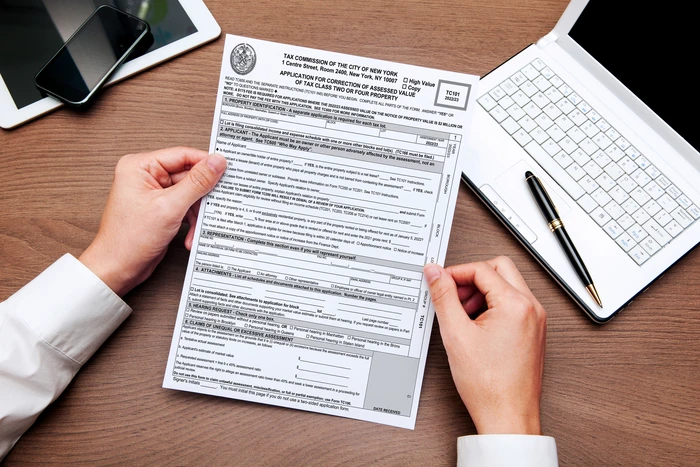
The application form follows the property: TC108 for valuation claims on Tax Class 1 properties, TC101 for Class 2 or 4 properties other than condominium units, TC109 for condo units in Class 2 or 4, and TC106 for claims about tax classification or exemptions. The Commission’s general instructions live on Form TC600, How to Appeal a Tentative Assessment.
The attachments are where applications are won or lost. An income-producing property files a statement of income and expenses, on TC201 for rentals or TC203 where a co-op or condo board is the applicant, and that statement must be consistent with the RPIE filing the same building made to Finance. For 2026-27 an accountant’s certification on Form TC309 is required only for rent-producing properties filing Form TC201 with a tentative actual assessed value of $5,400,000 or more and income above $100,000. And beginning with 2026-27, the Commission imposes a $175 fee on applications where the assessed value is $2 million or more, billed on the property tax bill itself.
What happens at the hearing?
The case is evaluated in person by a hearing officer, on the record the application and its schedules built. If the Commission finds merit it can offer a correction: a reduction in assessed value, or the exemption restored. The requirements vary significantly among property types, which is exactly why the application and its attachments deserve professional preparation rather than a form filled in at the deadline.
A determination that leaves the owner aggrieved is not the end of the road: further review runs to court under Article 7 of the Real Property Tax Law, through counsel, on a separate calendar.
How is this different from a DOF Request for Review?
The Department of Finance and the Tax Commission are separate agencies. The Request for Review asks Finance to correct its own work; the Tax Commission application puts the assessment in front of an independent reviewer, and only the Tax Commission track carries the case toward judicial review. Finance’s own descriptive errors, wrong square footage, wrong unit counts, go to Finance. The strategy for most wrongly assessed properties is both filings on both calendars, and MGNY runs them together; the Finance side of that pairing is described on our Finance Department Appeals page.
The Commission has also become the forum for the newest appeal in the City: challenges to the Non-Primary Residence Surcharge, which we handle as part of our surcharge practice.
How does MGNY handle a Tax Commission appeal?
We determine the correct form for the property, build the income and expense schedules so they reconcile with the building’s RPIE filing, obtain the TC309 certification where the assessed value requires it, file by the received-by deadline, and appear for the hearing with the case organized the way hearing officers actually read it. Call (212) 343-1111 before the March calendar closes.
Frequently asked questions about Tax Commission appeals
How do property tax appeal services work?
The service is evidence and calendar. A professional filer reads the Notice of Property Value, determines what is wrong (value, class, or exemption), files the correct application form with the schedules that prove the claim by the received-by deadline, and argues the case at the hearing. In New York City that means the Tax Commission application, usually paired with a DOF Request for Review.
When is the NYC Tax Commission deadline?
March 1 for Tax Classes 2, 3 and 4, and March 15 for Tax Class 1. For 2026 the received-by dates are 5 PM March 2 and 5 PM March 16, because the statutory dates fall on Sundays.
What is Form TC201?
The Tax Commission’s income and expense schedule for rental properties, filed with the application for an income-producing building. Co-op and condo boards file TC203 instead. The figures must hold together with the building’s RPIE filing to Finance.
Do I need an accountant’s certification?
For 2026-27, an accountant’s certification on Form TC309 is required only for rent-producing properties filing Form TC201, where the parcel’s tentative actual assessed value is $5,400,000 or more and income exceeds $100,000. A co-op or condo board filing TC203 does not file it.
Can the Tax Commission review an exemption denial?
Yes, once you have applied to Finance or Finance has acted. Exemptions denied, reduced, revoked or removed, including J-51, 421-a, ICIP and nonprofit exemptions, are within the Commission’s review alongside value and classification.
Two explainers sit behind this service: the notice that starts the calendar and what tax certiorari is, the appeal by its legal name.
Filing locations, borough roll numbers and the deadlines that apply to each borough are on our pages for Brooklyn, the Bronx, Queens, Manhattan and Staten Island.
The assessment you are appealing comes from the Department of Finance, and the result shows up on the property tax bill; both pages explain where to look.
 Go Back