What Is J-51? The NYC Abatement for Renovated Buildings, Its Expiry, and the Program That Replaced It
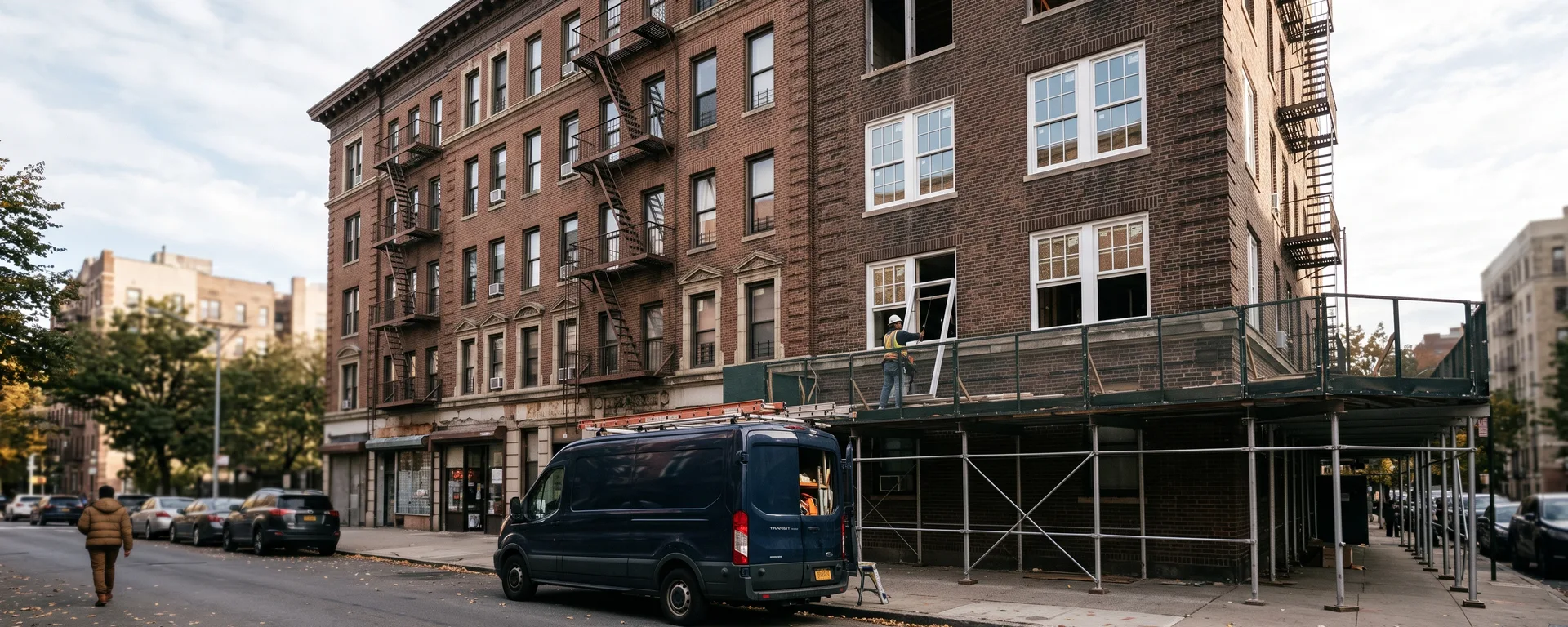
J-51 was NYC's tax exemption and abatement for building rehab. The benefit it paid, the rent stabilization it carries, and the J-51 R program that replaced it.
Updated September 2026. The original J-51 closed to work completed after June 29, 2022, and its 2024 replacement, J-51 R, is the live program. As of September 2026 HPD says it is still accepting J-51 R applications for work completed on or before June 29, 2026, and that later work cannot be filed until the City Council enacts the extension the State authorized through June 30, 2036. MGNY handles both sides of that line on our J-51 service page.
J-51 is the tax break New York City owners still argue about years after it stopped issuing benefits, because two things outlive it: abatement schedules still running on thousands of buildings, and the rent stabilization that came attached. HPD said in February 2025 that the program had rehabilitated more than 3,200 buildings since 2009, covering rent levels in over 143,000 homes.
What is the J-51 tax abatement?
J-51 is, in HPD’s words, an as-of-right tax exemption and abatement for residential rehabilitation or conversion to multiple dwellings. It is also written J51, without the hyphen, as in the address of DOF’s own J-51 page, so “J51 tax abatement” and “J-51 tax abatement” refer to the same program. Two benefits ran under one name: the exemption kept the tax increase caused by the work off the bill, and the abatement cut the building’s existing taxes by a share of what the work cost. It is governed by Real Property Tax Law 489 and Administrative Code 11-243, with Chapter 5 of Title 28 of the Rules of the City of New York, and HPD warns that where the Rules and the Laws disagree, the Laws govern. Two agencies split the job, and still do: HPD determines eligibility and issues the Certificate of Eligibility, Finance administers the benefit.
What did J-51 pay for, and how much was it worth?
Eligible work included government-assisted or privately financed moderate and gut rehabilitation, major capital improvements such as asbestos abatement or boiler replacement, and, for projects completing on or after December 31, 2011, non-residential conversions only with substantial governmental assistance. Co-op and condo projects qualified with an average assessed value under $30,000 per dwelling unit, or above that only with substantial governmental assistance.
The exemption ran 34 years on affordable housing projects, 30 full plus a 4-year phase out, and 14 years on most others. The abatement cut existing real estate taxes by up to 8 1/3 percent or 12 1/2 percent of the cost of the work each year for up to 20 years, subject to the assessed valuation ceiling in the table below. For projects completed on or after December 31, 2011, work had to finish within 30 months, the application filed within 36 months of commencement and completed within 12, and the fee was $500. Our guide to NYC tax abatements puts J-51 beside the other programs.
Why are apartments in J-51 buildings rent stabilized?
Because the statute makes the tax benefit conditional on it. HPD states the rule plainly: all rental units become subject to rent stabilization or rent control for the duration of the benefits. Those units must be registered with the State Division of Housing and Community Renewal, and the Court of Appeals called them generally subject to rent stabilization for at least as long as the J-51 benefits are in force. That came in Roberts v Tishman Speyer Properties, L.P., decided October 22, 2009, the Peter Cooper Village and Stuyvesant Town case, where the Court agreed with tenants that owners could not use luxury decontrol under the Rent Stabilization Law while taking J-51 benefits. J-51 also caps what an owner charges for the work: the MCI rent increase must be reduced by part of the abatement’s value, and is restored only when the abatement ends. The rent stabilization explainer covers the wider system.
What happens when a J-51 abatement expires?
RPTL 489(7)(b)(2) sets out the exit, and it turns on lease paperwork. A unit regulated only because of the tax benefit stays regulated until the first vacancy after the benefits stop. It leaves earlier, at the end of the benefit period, only if every lease and renewal for the tenant in residence at expiry carried a notice in at least twelve-point type saying the unit becomes subject to deregulation when the period ends, and stating the approximate expiry date. Both paths close if the unit would have been regulated anyway under the Rent Stabilization Law of 1969 or the Emergency Tenant Protection Act of 1974, which is what caught the owners in Roberts. Nothing filed after expiry creates the notice.
When did J-51 expire, and what replaced it?
The statutory completion deadline was June 29, 2022, and HPD accepts no applications for work completed after it. The replacement came in two steps. Chapter 536 of the Laws of 2023 added a subdivision to RPTL 489 authorizing a successor, and New York City enacted Local Law 122 of 2024, codified at Administrative Code 11-243.2. HPD then added Chapter 62 of Title 28 RCNY to implement it, effective June 20, 2025. Applications opened in February 2025, aimed at rent-regulated buildings, co-ops and condos, including work done to comply with Local Law 97.
What does J-51 R require, and what does it pay?
J-51 R is an abatement only, with no exemption leg. It cuts existing real property taxes by up to 8 1/3 percent of the total certified reasonable cost each year for up to 20 years, capped at 70 percent of that cost in total. The annual abatement can never exceed the taxes payable that year, and is capped at 50 percent of taxes payable for Mitchell-Lama and redevelopment company rentals, co-ops and condos, and regulated homeownership buildings. Eligible work must appear on HPD’s certified reasonable cost schedule, cost at least $1,500 per dwelling unit, finish after June 29, 2022 and, as the rules stood in September 2026, on or before June 29, 2026 (the statute says before June 30, 2026), run no more than 30 months from commencement, and add no cubic content.
| Original J-51 (Admin Code 11-243) | J-51 R (Local Law 122 of 2024, Admin Code 11-243.2) | |
|---|---|---|
| Work completed | On or before June 29, 2022 | After June 29, 2022 and on or before June 29, 2026, as of September 2026 and pending City Council action on the State-authorized extension |
| Exemption | 34 years for affordable projects, 14 years for others | None |
| Abatement | Up to 8 1/3% or 12 1/2% of the cost of the work per year, 20 years | Up to 8 1/3% of certified reasonable cost per year, 20 years, 70% in total |
| Assessed value limit | Rentals: $30,000 average per unit, $40,000 after the amending local law | $45,000 average per unit at commencement, co-ops and condos |
| Eligible buildings | Moderate and gut rehab, MCIs, conversions with substantial governmental assistance | Rentals with 50% of units at or below 30% of 80% AMI and registered with DHCR, Mitchell-Lamas, or substantial governmental assistance; qualifying co-ops and condos |
| MCI rent increase | Reduced by part of the abatement value, restored at the end | Permanently waived for the subsidized work |
| Application deadline | File within 36 months of commencement, complete within 12 | Within four months of completion, or by April 30, 2025 for work completed on or before December 30, 2024 |
| Fee | $500 | $1,000 plus $75 per dwelling unit over six |
The J-51 R clock starts before the work does. A Notice of Intent must reach HPD’s J-51 unit no less than 15 days before rehabilitation starts, and missing it costs the larger of $500 or 10 percent of the fee. Tenant notice must be posted at least 30 days and no more than 180 days before commencement. Covered rental units stay stabilized for at least the restriction period, defined in statute as fifteen years from initial receipt of benefits.
What does an owner with an existing J-51 benefit still have to file?
An old benefit is not a finished matter. Rental units must stay registered with DHCR for the life of the benefit, and the twelve-point-type deregulation notice has to sit in each lease and renewal before expiry, not after. The Department of Finance publishes a J-51 benefit history lookup by borough, block, lot and tax year, the fastest way to confirm what a building carries and when it ends. A building that has held J-51 or J-51 R benefits must also file an Affidavit of Non-Duplication with any new application.
What does it cost to ask MGNY?
Nothing. A real person answers at (212) 343-1111, right away, and the consultation is free. You engage us only if you want the filing handled for you. MGNY has worked NYC property tax since 2008, with $50M+ in tax refunds secured for owners, 900+ developments with tax abatements secured and $30B+ represented in appeals.
Finishing work near the June 29, 2026 line, or holding a J-51 benefit about to expire?
Send us the building and we will tell you which program it lands in. See our J-51 service page, or call (212) 343-1111 and we will look with you.
Sources, all read September 2026: NYC Department of Housing Preservation and Development, J-51 and J-51 Reform program pages, the J-51 R FAQs of April 23, 2025 and press release 007-25 of February 12, 2025; NYC Department of Finance, J-51 Exemption and Abatement; Real Property Tax Law 489, subdivisions 7, 21 and 22, on the State Senate site; HPD’s Notice of Adoption for Chapter 62 of Title 28 RCNY, effective June 20, 2025 per NYC Rules; Roberts v Tishman Speyer Properties, L.P., 13 NY3d 270, October 22, 2009. MGNY Consulting is a private consulting firm and is not affiliated with the NYC Department of Finance or the NYC Department of Housing Preservation and Development.
Get our updates first on Google. Deadlines move: J-51 R work completed after June 29, 2026 cannot be filed at all until the City Council enacts the extension the State authorized through June 30, 2036. Tap the button and Google adds MGNY Consulting to your preferred sources, so our coverage surfaces first in your results. No signup and no email, and one tap undoes it.