The NYC Zoning Resolution: How Does It Work, and What Did City of Yes Change?
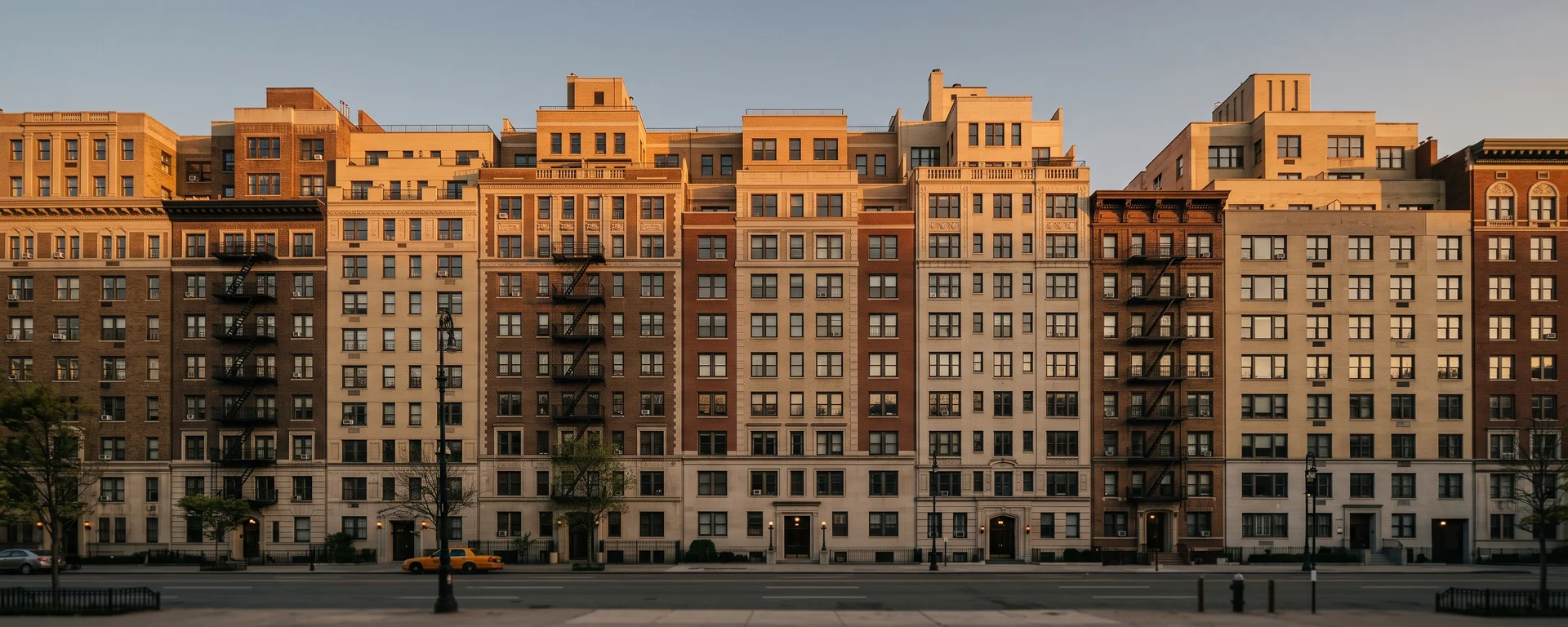
The NYC Zoning Resolution calls itself the 1961 Zoning Resolution: 14 articles, 11 appendices. Here are the districts, FAR, and what City of Yes changed.
Updated September 2026. The NYC Zoning Resolution’s home page states that it carries “All text changes approved by the city council as of Aug 13, 2026.” City of Yes for Housing Opportunity, adopted December 5, 2024, added Article II Chapter 7, rewrote the bulk tables in Sections 23-22 and 23-432, and created six residence districts, R6-1, R6-2, R6D, R11, R11A and R12. Appendix B, the special purpose district index, was last amended November 12, 2025. For the reform in plain English, see what City of Yes is.
Zoning decides what may be built on a lot, and in New York City all of it lives in one document. Owners meet it twice, first when an architect says a project fits, then again when the tax consequences arrive.
A zoning question may also create tax and affordable-housing filing work. MGNY handles 485-x applications; architects and zoning counsel address zoning design and approvals. Discuss your project’s tax requirements with its uses, unit count, permit status and construction timetable.
What is the New York City Zoning Resolution?
It is the city’s land use rulebook. The Resolution calls itself “the 1961 Zoning Resolution,” dates its control section 11-11 to December 15, 1961, and now carries text changes approved through August 13, 2026. Its publisher, the Department of City Planning, describes it in one sentence on the front page of zr.planning.nyc.gov: “The Zoning Resolution consists of 14 Articles and 11 Appendices, plus 126 Zoning Maps, that establish the zoning districts for the City and the regulations governing land use and development.”
The same paragraph gives the shape. “Articles I through VII contain the use, bulk, parking and other applicable regulations for each zoning district. The three major articles are Article II, with regulations for residence districts, Article III for commercial districts, and Article IV for manufacturing districts. Articles VIII through XIV set forth the purpose and regulations for each Special Purpose District.”
Article I holds definitions, Article V the rules for non-conforming uses and non-complying buildings, Article VII the variances and special permits. Two appendices matter commercially: B indexes the special purpose districts, F the Mandatory Inclusionary Housing areas and the former Inclusionary Housing Designated Areas.
Who administers the Zoning Resolution, and how does it get amended?
Section 71-00, still carrying its 1961 date, names the enforcing agency: “The Commissioner of the Department of Buildings shall administer and enforce this Resolution, except as otherwise specifically provided in the New York City Charter and in this Resolution.” The same section hands the air pollution provisions to the Department of Environmental Protection, which holds “exclusive jurisdiction” over them.
Changing the text runs elsewhere. Section 71-10 says “The City Planning Commission shall adopt resolutions to amend the text of this Resolution or the zoning maps incorporated therein, and the City Council shall act upon such amendments, in accordance with the provisions of the New York City Charter.” The Commission adopts the amending resolution, and the Council acts on it after that.
Map changes and text changes run different routes, and City Planning’s review flowchart is blunt about it. A zoning map change runs the full Uniform Land Use Review Procedure clock: 60 days at the community board, 30 at the borough president and borough board, 60 at the Commission, then the Council. A zoning text change is missing from that ULURP action list and shows up instead as “Zoning text changes (non-ULURP)” in the box headed “AUTOMATIC REVIEW BY CITY COUNCIL,” alongside zoning map changes. Not a ULURP action, but never a quiet one either.
How do you find the zoning on a particular lot?
The tool is ZoLa, at zola.planning.nyc.gov, which titles itself “ZoLa | NYC’s Zoning & Land Use Map.” HPD points applicants to it by name, telling them in its April 2025 UAP fact sheet that former Inclusionary Housing Designated Areas are “listed by Borough and Community District in Appendix F of the Zoning Resolution and viewable online at the Department of City Planning’s ZoLa map.” Read the district code the map shows against the district text in the Resolution itself.
One caution on the answer. A district code gives the rules that apply now, not the rules a building was built under, and an older one may be non-complying under Article V.
What do R6, C4-2 and M1-5 mean?
The letter names the family, and the first number the density in residence districts and the intensity of permitted uses in commercial and manufacturing ones. Section 11-121 gives the rest: a second number after a hyphen, the 2 in C4-2 or the 5 in M1-5, “denotes differences in bulk or parking regulations within a common use category.” Section 11-122, Districts established, last amended August 14, 2025, is the master list.
| Letter | Family | Districts in 11-122 | Range and naming |
|---|---|---|---|
| R | Residence | 47 | R1-1 through R12. Suffixes such as R6A, R6B and R6D are contextual variants with their own bulk rules. |
| C | Commercial | 100 | C1 and C2 Local, C3 Waterfront Recreation, C4 and C7 General Commercial, C5 and C6 General Central Commercial, with five C6 districts named Restricted Central Commercial, C8 General Service. |
| M | Manufacturing | 36 | M1 Light, M2 Medium, M3 Heavy. |
From Section 11-122, read September 6, 2026.
The residence range grew in 2024. City Planning’s annotated text for City of Yes for Housing Opportunity heads the change to 11-122 “ALIGNING WITH PROPOSAL TO INCLUDE ADDITIONAL HOUSING TYPES IN EXISTING DISTRICTS AND CREATE NEW DISTRICTS,” and its margin note reads “The Proposal establishes a series of new mid- and high-density districts.” The annotated text underlines six new residence districts in that list: R6-1, R6-2, R6D, R11, R11A and R12, whether or not a block is yet mapped into one.
What is floor area ratio, and what else sets the size of a building?
Floor area ratio is the multiplier: FAR 3.00 on a 10,000 square foot zoning lot permits 30,000 square feet. Section 23-22, last amended December 5, 2024, holds the residential table, and sets separate maximum floor area ratios “for zoning lots containing standard residences and zoning lots containing qualifying affordable housing or qualifying senior housing.”
| District | Standard residences | Qualifying affordable or senior housing |
|---|---|---|
| R6B | 2.00 | 2.40 |
| R7A | 4.00 | 5.01 |
| R8A, R8X, R8 | 6.02 | 7.20 |
| R10A, R10X, R10 | 10.00 | 12.00 |
| R11 | 12.00 | 15.00 |
| R12 | 15.00 | 18.00 |
Selected rows from Section 23-22, which also footnotes rates within 100 feet of a wide street.
FAR alone does not draw a building. Lot coverage, in Section 23-362, caps the share of the lot built on. Height and setback, in Section 23-432, fix a minimum base height, a maximum base height and a maximum height, rewritten the same day with a second column set. In R12 the standard maximum is 325 feet, and 395 with qualifying affordable or senior housing.
What is a special purpose district?
A special purpose district is a local rewrite mapped on top of the ordinary district, and Articles VIII through XIV are nothing but these. Read September 6, 2026, Appendix B was last amended November 12, 2025 and lists 91 in its index plus 22 more under its heading for districts eliminated or replaced, each with its symbol, section number and adoption dates.
Two examples: the Special Clinton District (CL) at Section 96-00, adopted November 21, 1974, and the Special 125th Street District (125) at Section 97-00, adopted April 30, 2008. Section 11-123 gives the mechanism. Each “appears on the zoning maps superimposed on other districts and its regulations supplement or modify those of the districts upon which it is superimposed.” Miss the overlay and the table misleads.
What did City of Yes change in the Zoning Resolution?
City of Yes is three amendments, each with its own adoption date, and four application numbers among them.
| Amendment | Application number | Adopted | Subject |
|---|---|---|---|
| Carbon Neutrality | N 230113 ZRY | 12/6/2023 | Renewable energy, retrofits and electrification, EV charging, and water, compost and recycling rules. |
| Zoning for Economic Opportunity | N 240010 ZRY, plus N 240011 ZRY for M districts | 6/6/2024 | The use groups themselves, rebuilt across Sections 32-00 and 42-00. |
| Housing Opportunity | N 240290 ZRY | 12/5/2024 | Residential bulk, parking, ancillary dwelling units, conversions, Article II Chapter 7, districts R6-1, R6-2, R6D, R11, R11A and R12. |
Housing Opportunity is the one owners feel. The City Council calls it “A citywide zoning text amendment, initiated by the Department of City Planning and modified by the Council, to change residential height, density, parking requirements, affordability, urban design, and other aspects within city zoning regulations,” and “the first citywide zoning text amendment designed to increase housing production across all neighborhoods,” estimated to create over 82,000 units over 15 years.
One misreading is worth killing early. City Planning’s September 2024 FAQ answers it flatly: “The proposal will not change the zoning designation of any site. Every zoning designation remains the same. If you are an R2 today, you will be an R2 tomorrow.” The tables moved, not the labels on the map. Our siblings on the Universal Affordability Preference, on ancillary dwelling units and on office to residential conversion take each piece apart.
Where does zoning meet property tax and the housing programs?
At three seams, none obvious from a district code.
The first sits inside the Resolution. Article II Chapter 7, dated December 5, 2024 throughout, is where the affordable housing programs live: 27-11 defines the terms, 27-15 covers MIH and UAP zoning lots, and 27-16 sets the requirements, among them, in new construction that mixes affordable and other units, distribution across at least 65 percent of the residential stories. Unit size is the one people misread. 27-16(d) tests averages, not single units, and takes the lower of two figures: the average size of the market rate units with the same bedroom count, or a listed minimum running from 400 square feet for a studio to 950 for a three-bedroom. Our explainer on mandatory inclusionary housing works through the options and Appendix F.
The second is eligibility for a tax exemption. HPD’s rule for Option C of 485-x, the small rental option, is that “The project cannot be located on a zoning lot that permits residential floor area exceeding 12,500 sq. ft.” A zoning fact deciding a tax outcome. That option of 485-x carries a zoning test alongside its unit count, rent stabilization and borough tests, and its conversion cousin 467-m turns on what the building was before the work, since that exemption runs only to conversions of non-residential buildings.
The third seam is the one people get wrong. Nothing in the Department of Finance’s class definitions turns on a zoning district. The Department of Finance defines the classes by use and unit count: Class 1 is “Most residential property of up to three units,” Class 2 “All other property that is not in class 1 and is primarily residential,” Class 3 “Most utility property,” Class 4 “All commercial and industrial properties.” on a building already in use the class follows the use, not the map, a point that runs through how NYC property tax works.
How do you read a citation like 23-22 or 27-16(c)?
The digits before the hyphen are the article and then the chapter. In Articles I through IX the first digit is the article and the second the chapter, and in Articles X through XIV the first two digits are the article, so Willets Point at 124-00 is Article XII, Chapter 4. The part after the hyphen is the section. So 23-22 is Article II, Chapter 3, Section 22, residence districts and bulk. Sub-sections add digits: 23-432 sits under 23-43, which sits under 23-40. Lettered paragraphs live inside a section, so 27-16(c) is paragraph (c) of 27-16.
Worked through, 27-16(c) is titled “Bedroom mix of affordable housing units.” It requires either a mix “at least proportional to the bedroom mix of the dwelling units” that are not affordable, or that “not less than 50 percent of the dwelling units that are affordable housing units shall contain two or more bedrooms and not less than 75 percent” contain one or more. HPD cites it as “ZR §27-16(c).”
NYC Zoning Resolution questions, answered
Where do you read the NYC Zoning Resolution text online?
At zr.planning.nyc.gov, the Zoning Resolution on the Department of City Planning’s own website, with a full PDF download and a per-section copy link. Read in September 2026 it holds every text change approved through August 13, 2026.
How many zoning districts does New York City have?
Section 11-122 lists 47 residence, 100 commercial and 36 manufacturing districts. Appendix B indexes 91 special purpose districts as of its November 12, 2025 amendment, and lists 22 more as eliminated or replaced.
What does FAR mean in NYC zoning?
Floor area ratio, the multiple of the zoning lot area you may build. Residential FAR for R6 through R12 sits in Section 23-22, which since December 5, 2024 gives a higher figure for qualifying affordable or senior housing.
What is R6 zoning in NYC?
A General Residence District, as Section 11-122 names it. Under Section 23-22 a plain R6 outside 100 feet of a wide street carries a residential FAR of 2.20, or 3.90 with qualifying affordable or senior housing.
Does a zoning text amendment go through ULURP?
No. City Planning’s land use review chart lists map changes as ULURP actions and leaves text changes off that list, putting “Zoning text changes (non-ULURP)” in the automatic Council review box, alongside zoning map changes.
Is the Zoning Resolution the same as the building code?
No. The Resolution governs use, bulk and density on a zoning lot; the Construction Codes, in the Department of Buildings’ words, “consist of the General Administrative Provisions, Building Code, Fuel Gas Code, Mechanical Code, and Plumbing Code.” The Department of Buildings enforces the Resolution under Section 71-00, apart from its air pollution provisions, which the Department of Environmental Protection enforces, and Buildings is also the department that publishes the Construction Codes.
What does it cost to ask MGNY?
Nothing. A real person answers at (212) 343-1111, right away, and the consultation is free. You engage us only if you want the work handled for you. MGNY has worked NYC property tax since 2008, with nearly $300M in tax savings secured for owners, 900+ developments with tax abatements secured and $30B+ represented in appeals.
The zoning answer is the easy half. The tax consequences are the expensive half.
MGNY is not a zoning consultant. We handle what the zoning unlocks: the 485-x filing, the MIH and UAP marketing agent and monitor work, the lottery and lease-up, and the assessment. Call (212) 343-1111.
Sources: the New York City Zoning Resolution at zr.planning.nyc.gov, its Preamble and Sections 11-11, 11-111, 11-121, 11-122, 11-123, 11-42, 12-10, 23-22, 23-362, 23-432, 27-11 to 27-16, 71-00 and 71-10, Appendix B and the recently adopted pages for City of Yes for Carbon Neutrality, Economic Opportunity with its M Districts companion and Housing Opportunity; City Planning’s ULURP chart, City of Yes FAQ and annotated zoning text; ZoLa; HPD’s Inclusionary Housing and 485-x pages and UAP fact sheet; the Department of Finance’s assessment definitions; and the City Council’s December 5, 2024 press release announcing its passage. All read September 6, 2026. MGNY Consulting is a private consulting firm and is not affiliated with the NYC Department of City Planning, the NYC Department of Housing Preservation and Development or the NYC Department of Finance. The Carbon Neutrality summary comes from DCP’s City of Yes applicability deck, the 467-m sentence from HPD’s 467-m page, and the Construction Codes sentence from the Department of Buildings’ Codes page.
See our updates more often on Google. The text moves: Appendix B was last amended on November 12, 2025, and the Resolution now carries text changes through August 13, 2026. Tap the button and Google adds MGNY Consulting to your preferred sources, so our coverage appears more often in Top stories when it is relevant to your search. No signup and no email, and one tap undoes it.