Office to Residential Conversion in NYC: The City of Yes Rules and the 467-m Tax Exemption
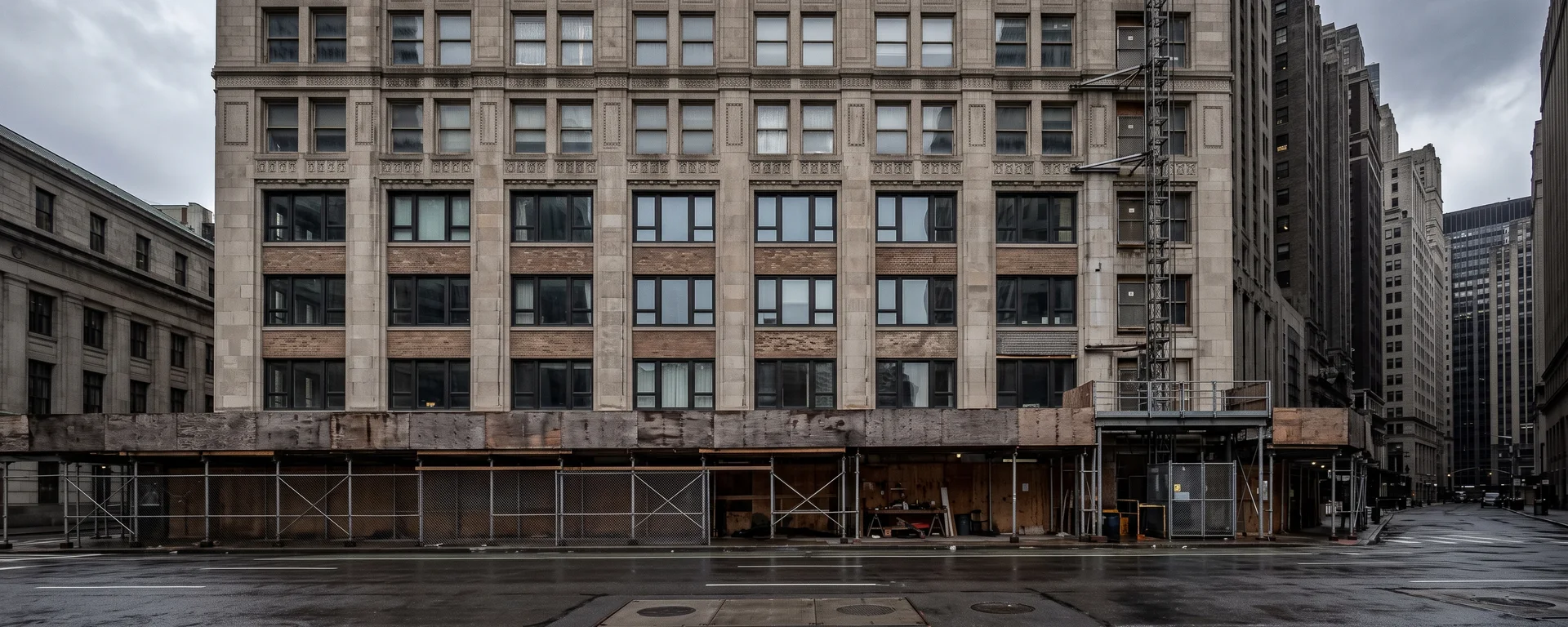
City of Yes opened office to residential conversion in NYC to buildings existing on December 31, 1990. Here are the zoning rules and the 467-m exemption.
Updated September 2026. In an office to residential conversion in NYC, zoning governs the use and state tax law governs the exemption, and Multiple Dwelling Law 26(3) caps the floor area ratio of dwellings at 12.0 except on the conditions it lists. Zoning decides whether it may become housing: since December 5, 2024, City of Yes extends the Zoning Resolution’s conversion chapter to buildings existing on December 31, 1990, wherever residential use is allowed, though the Chapter does not reach M1-5B Districts except as Section 15-024 provides. Tax decides whether the numbers work, and that is RPTL 467-m, whose 35-year tier closed to permits pulled after June 30, 2026. A permit pulled today buys 30 years, a band closing June 30, 2028. Own the building? MGNY’s tax opinions and projections team prices the exemption.
An office becomes apartments under two separate bodies of law people merge into one. The Zoning Resolution says whether the use may change. State tax law says whether the City forgives the tax. The text amendment behind it is City of Yes.
What did City of Yes change for office to residential conversion in NYC?
Conversions live in Article I, Chapter 5 of the Zoning Resolution, Residential Conversion within Existing Buildings. Amendment N 240290 ZRY, adopted December 5, 2024, rebuilt it. Sections 15-00, 15-01, 15-021, 15-10, 15-11, 15-111, 15-12, 15-20 and 15-21 were rewritten; 15-011, 15-012, 15-013, 15-211 through 15-215, 15-22 through 15-26, 15-30, 15-40, 15-41, 15-50 and 15-51 were deleted. The deleted sections carried the old applicability rules for special purpose districts and for C6-1G, C6-2G, M1-5B and M1-6D Districts, the preservation-and-conversion machinery that hung under the old 15-20 heading for the C6-2M, C6-4M, M1-5M and M1-6M districts, and a transition rule for building permits and variances issued before the effective date of amendment. Two titles survive under new numbers: the old 15-40 AUTHORIZATION and 15-41 Enlargements of Converted Buildings are now 15-20 and 15-21. The superseded eligibility rules for named Community Districts, carrying December 15, 1961 and January 1, 1977, sat in Section 15-01 itself, which was amended rather than deleted.
Section 15-01 now opens: “Conversions in buildings or portions thereof, existing on December 31, 1990, shall be subject to the provisions of this Chapter.” One date, citywide, though a Special Mixed Use District reaches buildings existing on December 10, 1997. City Planning’s FAQ described the change as letting buildings “convert wherever residential use is allowed” and as a move “up the eligibility date to 1991.”
Several limits survive. Conversion is “permitted only in districts where residential use is allowed,” so a manufacturing district needs a path this Chapter itself supplies, or an authorization or special permit, and transient hotels stay limited to buildings eligible “prior to December 5, 2024.” Section 15-11 then does the heavy lifting, permitting conversion of floor area “that exceeds the maximum floor area permitted by the applicable district regulations,” Unit count still runs through Section 23-50. The amendment is estimated to create over 82,000 housing units over 15 years, and the Council secured $5 billion in City and State funding commitments for its City for All housing plan alongside it, and the rest runs from the Universal Affordability Preference to accessory dwelling units.
Multiple Dwelling Law Section 26(3) says the floor area ratio “of any dwelling or dwellings on a lot shall not exceed 12.0.” A 2024 chapter allowed an exception in a city of one million or more, on six conditions. Two set the shape: a public land use review, and affordability “equivalent to or exceeding the requirements under any mandatory inclusionary housing program,” meaning Mandatory Inclusionary Housing or its equal. The other four turn on artists’ quarters and article 7-C buildings on the lot, historic districts, a certificate of no harassment, and compensation to displaced households.
Which buildings qualify for the 467-m tax exemption?
The tax half is Real Property Tax Law Section 467-m, which HPD administers as Affordable Housing from Commercial Conversions, or AHCC. It covers “conversions of non-residential buildings, except a hotel or other class B multiple dwelling.” Four tests define the building.
- Six or more dwelling units, all operated as rentals.
- A Commencement Date after December 31, 2022 and on or before June 30, 2031.
- A Completion Date on or before December 31, 2039.
- A prior non-residential certificate of occupancy covering “not less than ninety percent of the aggregate floor area,” or other proof of that use HPD will accept from the building’s administrative record.
Both dates are terms of art. The Commencement Date is the day DOB issues the qualifying permit, and HPD’s bulletin names three job types: DOB NOW ALT-CO and Alteration CO with General Construction, plus DOB BIS Alteration Type 1 with OT General Construction. The Completion Date is the first temporary or permanent certificate of occupancy covering all residential areas, so a TCO starts the clock.
Two thresholds catch people. At least fifty percent of the finished floor area must be the pre-existing building, and commercial, community facility and other non-residential space is covered only up to 12% of total floor area. A non-residential portion of a mixed building can qualify in its own condominium tax lot. The program is citywide and as-of-right.
What are the 467-m affordability rules?
Five tests, one sentence in the statute. Not less than 25% of the dwelling units are affordable. Not less than 5% of the dwelling units are “affordable housing forty percent units”, in the statute’s words, though HPD’s Requirements FAQ instead asks the Workbook to show 5% of the Affordable Housing Units at or below 40% of AMI. The weighted average of all income bands stays at or below 80% of AMI. There are no more than three bands, none above 100% of AMI. On 200 units that is 50 affordable apartments, and between 3 and 10 of them at 40% of AMI depending on which denominator HPD applies to the Workbook, so confirm the count with HPD before pricing the tranche.
The restriction does not expire. HPD is flat about it: “Affordable Housing Units are permanently subject to Rent Stabilization.” The statute runs that period from the completion date “and extending in perpetuity, notwithstanding any earlier termination or revocation of AHCC program benefits.” Market units are not stabilized unless they would have been anyway.
Distribution is regulated too. Affordable units share “the same common entrances and common areas as rental Market Units” and may not be “isolated to a specific floor or area.” The bedroom mix is either proportional to the market units or hits a fixed rule: at least 50% with two or more bedrooms, no more than 25% with less than one. Building service employees get the prevailing wage unless the building has under thirty units or is substantially government-assisted.
How long does the 467-m exemption run, and what does it cost to apply?
Two variables set the benefit: the Commencement Date, and whether the tax lot sits inside the Manhattan Prime Development Area, meaning a tax lot “entirely south of 96th Street.” The construction period comes first, 100% for up to three years.
| Commencement Date | Term | Exemption inside the MPDA | Exemption outside the MPDA |
|---|---|---|---|
| After 12/31/2022 to 6/30/2026 | 35 years | 90% for years 1-30, then 80, 70, 60, 50, 40 | 65% for years 1-30, then 50, 40, 30, 20, 10 |
| 7/1/2026 to 6/30/2028 | 30 years | 90% for years 1-25, then 80, 70, 60, 50, 40 | 65% for years 1-25, then 50, 40, 30, 20, 10 |
| 7/1/2028 to 6/30/2031 | 25 years | 90% for years 1-20, then 80, 70, 60, 50, 40 | 65% for years 1-20, then 50, 40, 30, 20, 10 |
HPD’s 467-m benefit schedule, read September 2026, excluding assessments for local improvements.
Read that first row against today’s date. The 35-year band closed to permits pulled after June 30, 2026, so a permit issued now buys 30 years, a band closing June 30, 2028. The Application comes late: not “earlier than the Completion Date” and no later than a year after. The fee is $3,000 per dwelling unit, market units included, 25% at the Workbook and 75% at the Application, so $600,000 on 200 units. Taxes stay due throughout, and arrears disqualify the property. A 467-m building “shall not receive any exemption from or abatement of real property taxation under any other law,” so an office carrying ICAP gives it up, and 485-x also reaches Eligible Conversions, so both get modelled first.
What is the Office Conversion Accelerator?
The Accelerator is a City program for office to residential conversions, giving owners “a single point of contact within city government” so projects finish “in a Code-compliant and timely manner.” The City asks owners of a project that might provide “50 or more housing units” to reach out. It includes representatives from: City Hall, City Planning, Buildings, HPD, the Board of Standards and Appeals, Landmarks and others. Contact is a short web form.
Who markets and monitors the affordable apartments?
HPD’s marketing machinery handles it, not the owner’s leasing office. A Workbook goes in first, no more than twelve months before the anticipated Completion Date, naming every affordable unit, its rent, bedrooms and AMI band. Only after HPD approves it does the project file a Notice of Intent to begin marketing, followed by “an executed Marketing Monitoring Contract with a Marketing Monitor,” then a restrictive declaration.
Lease-up runs on NYC Housing Connect, where AHCC units appear under Open Lotteries, under the Marketing Handbook; the draw sits in how the NYC housing lottery works. The marketing agent must appear on HPD and HDC’s Marketing Agent Pre-Qualified List, a requirement codified in the April 1, 2025 Marketing Handbook update; An initial list of Qualified Marketing Agents was published on September 12, 2022. No affordable unit goes to a market household first. HPD anticipates seven to eight months from its approval of the marketing agent’s documents to lease-up. MGNY is an approved HPD marketing agent and an HPD-approved marketing monitor, and runs HPD lottery management.
What happens to the tax bill when a class 4 office becomes class 2 housing?
The building changes tax class, which moves the bill before any exemption applies. Finance defines class 4 as “all commercial and industrial properties, such as office, retail, factory buildings,” and class 2 as property “not in class 1” that is “primarily residential.” Both carry a 45% level of assessment.
| Item | Office, before | Rental housing, after |
|---|---|---|
| Tax class | Class 4 | Class 2, over 10 units |
| Level of assessment | 45% | 45% |
| Tax year 2026 rate | 10.848% | 12.439% |
| Assessment increases | Phased in at 20% a year, except for physical changes | Phased in at 20% a year, except for physical changes |
Finance rates and definitions, read September 2026.
The class 2 rate is higher, so a converted building with no exemption pays more per dollar of assessed value than the office did. Finance phases assessed value changes in on these classes at 20 percent a year, “20% of the change each year for five years,” with one exception it states in terms: “if you make physical changes to your property, the full value of the improvements is applied”, and “it is not transitioned in.” The property also stays income-producing, so the RPIE statement keeps coming above $40,000 of actual assessed value, with a rent roll addendum at $750,000 of actual assessed value and up. The path from assessment to bill sits in how NYC property tax works.
What does a conversion starting in 2026 look like on a calendar?
Take a 200-unit conversion outside the MPDA pulling its Alteration CO permit in late 2026. That permit date is the Commencement Date, landing in the 30-year band. Fifty units must be affordable, with the 40% of AMI tranche running from 3 units on HPD’s Workbook reading to 10 on the statute’s, a point to settle with HPD before the Workbook goes in.
No more than twelve months before the anticipated Completion Date the Workbook goes in with 25% of the fee, $150,000 here. HPD approves it, the Notice of Intent follows, the monitoring contract is executed, and marketing opens. Only on or after the Completion Date does the Application go in, with the remaining $450,000 and the restrictive declaration, within one year. Two outer dates bound everything: Commencement on or before June 30, 2031, Completion on or before December 31, 2039.
Office conversion questions, answered
Which buildings can convert to housing in NYC now?
A building existing on December 31, 1990, in a district where residential use is allowed, under Article I Chapter 5 of the Zoning Resolution as amended December 5, 2024, though the Chapter does not reach M1-5B Districts except as Section 15-024 provides and does not apply to a conversion that already meets Article II’s requirements in the listed R and C districts. A Special Mixed Use District uses December 10, 1997.
What is the 467-m tax exemption?
A property tax exemption for converting a non-residential building, other than a hotel or class B multiple dwelling, into six or more rental units with at least 25% affordable. Terms run 25, 30 or 35 years plus construction.
When does a 467-m project have to start and finish?
The Commencement Date, the day DOB issues the qualifying permit, must fall after December 31, 2022 and on or before June 30, 2031. Completion must land on or before December 31, 2039.
How much does a 467-m application cost?
$3,000 per dwelling unit, market units included, non-refundable. A quarter is due with the Workbook, the balance with the Application. HPD may waive it where every unit is affordable and government-assisted.
Can a 467-m building also keep ICAP or another abatement?
No. The statute bars any other exemption or abatement of real property taxation while AHCC benefits run, and HPD confirms ICAP cannot run alongside.
Who leases the affordable units in a converted office?
A marketing agent on HPD and HDC’s prequalified list, through a Housing Connect lottery under the Marketing Handbook, with an HPD-approved monitor under contract.
What does it cost to ask MGNY?
Nothing. A real person answers at (212) 343-1111, right away, and the consultation is free. You engage us only if you want the work handled. MGNY has worked NYC property tax since 2008, with nearly $300M in tax savings secured for owners, 900+ developments with tax abatements secured and $30B+ represented in appeals.
Converting an office? The date on your DOB permit sets the benefit tier, and the schedule steps down again on July 1, 2028.
MGNY runs the 485-x filing sequence where that program fits, starting with the option analysis, runs the lease-up as an approved HPD marketing agent, and stays on as monitor. Ask us about 467-m before you file. MGNY does not provide zoning analysis, architecture or DOB filings. Call (212) 343-1111 and our tax opinions and projections team will price the exemption against your schedule.
Sources: Zoning Resolution Article I Chapter 5 and the adopted amendment N 240290 ZRY, with the pre-amendment text in City Planning’s Zoning Resolution archive; City Planning’s Housing Opportunity FAQ; the Council’s December 5, 2024 vote; RPTL 467-m and Multiple Dwelling Law 26; HPD’s 467-m page, Requirements FAQ, commencement bulletin, benefit schedule, 485-x page and Marketing page; the Office Conversion Accelerator; and Finance’s assessment definitions, transitional assessed value, tax rates and RPIE pages. All read September 6, 2026. MGNY Consulting is a private firm and is not affiliated with the NYC Department of City Planning, the NYC Department of Housing Preservation and Development or the NYC Department of Finance.
See our updates more often on Google. Deadlines move: the 35-year 467-m tier closed to Commencement Dates after June 30, 2026, and the program takes no new starts after June 30, 2031. Tap the button and Google adds MGNY Consulting to your preferred sources. No signup and no email, and one tap undoes it.