What Is UAP Zoning? The NYC Universal Affordability Preference, Explained
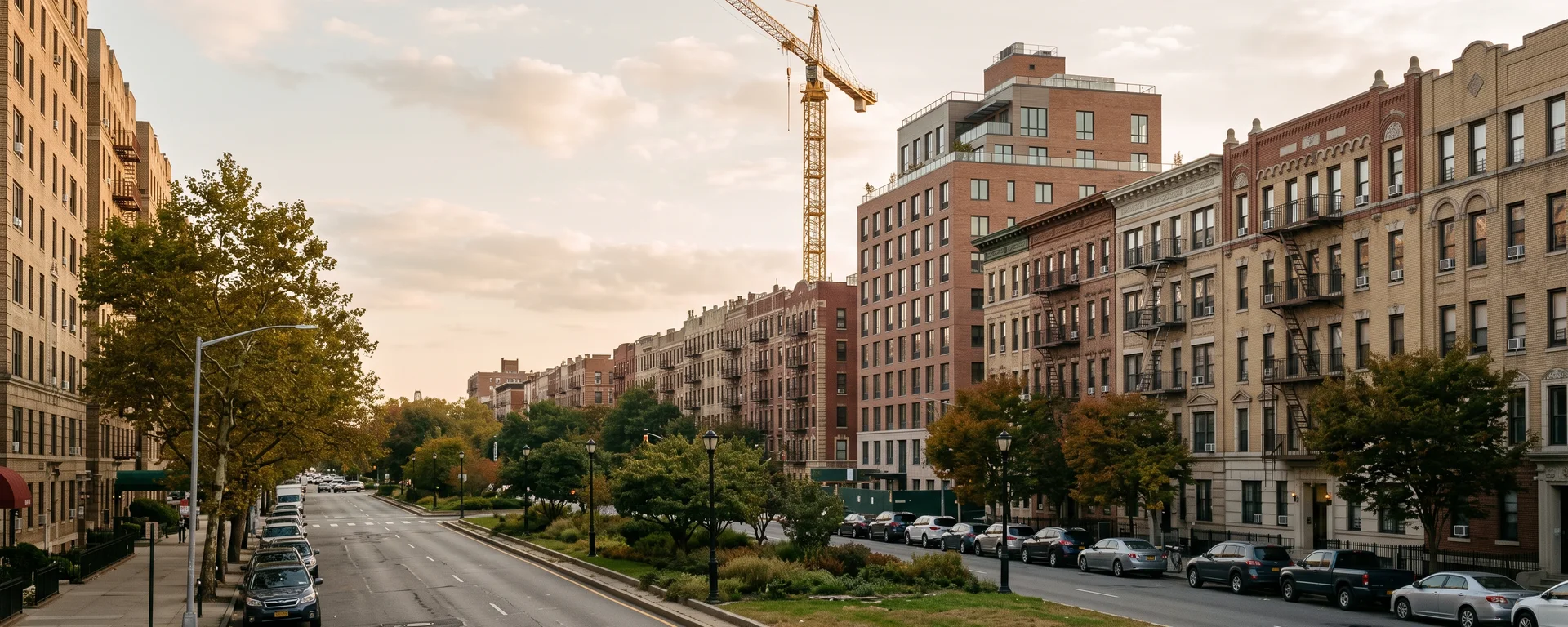
The Universal Affordability Preference lets R6 to R10 buildings outside MIH areas add floor area for affordable homes averaging 60% of AMI. How to file.
Updated September 2026. The Universal Affordability Preference is open, and HPD publishes the current UAP Affordable Housing Application and Checklist on its Inclusionary Housing page. The stacking charts and architect certification were reissued in August 2026, and HPD cut the studio household factor from 0.7 to 0.6 in the 2026 AMI, with the 2025 AMI still usable until the 2027 AMI is adopted. One old clock runs on: a pre-City of Yes Voluntary Inclusionary Housing new construction site that filed with DOB by December 5, 2024 and won DOB approval by December 5, 2025 keeps its old-rules treatment only if the regulatory agreement is executed and recorded by December 5, 2026. In a mapped MIH area instead? See Mandatory Inclusionary Housing.
UAP in NYC zoning is the Universal Affordability Preference, not the aerial phenomena that own the same three letters. It lets a building in a medium or high density district outside a Mandatory Inclusionary Housing area carry more floor area than the district allows, on one condition: the extra has to be permanently affordable housing. It arrived with City of Yes for Housing Opportunity on December 5, 2024, and HPD administers it as of right.
Leasing the income-restricted units in a UAP project requires attention to the building’s agreements and marketing requirements. MGNY supports owners with affordable housing lottery management. Discuss your project with its program documents, unit mix and anticipated availability to review the applicable lease-up work.
What is the Universal Affordability Preference, and what does it require?
The zoning opens its definition with one sentence. A UAP development is “a development or enlargement outside of a Mandatory Inclusionary Housing area that provides affordable housing or a supportive housing project that satisfies the requirements of this Chapter.” HPD puts it plainly: UAP “was established in December 2024 under the New York City Zoning Resolution,” and lets buildings “build 20% more housing if the additional homes are permanently affordable.” It “applies to R6 through R10 zoning districts,” only outside MIH areas, and its units “may be rental or homeownership.” The restriction is permanent, tied to the regulatory period: the whole time the floor area serves the development or the building is in use.
The affordability test has three parts that always bind and a fourth that binds on larger sites: units go to “households having an income less than or equal to a weighted average of 60 percent of the income index at initial occupancy,” with “no more than three income bands,” “no income band exceeding 100 percent of the income index,” and, “for UAP sites with 10,000 square feet or more of affordable floor area, at least 20 percent of such affordable floor area at an income band of no more than 40 percent of the income index.”
That last clause is the City Council’s: its summary of modifications answered the concern that “UAP does not require any deep-affordability units” by requiring “20% of UAP units in projects with at least 10,000 square feet of UAP floor area to be affordable for families earning 40% of the Area Median Income (AMI).” The income index is 200 percent of HUD’s Very Low-Income Limit for Multifamily Tax Subsidy Projects, which HPD adjusts for household size: HPD’s 2026 chart puts a three-person family at 100 percent at $152,700.
| Household size | 40% of AMI | 60% of AMI | 100% of AMI |
|---|---|---|---|
| 1 person | $47,520 | $71,280 | $118,800 |
| 2 people | $54,280 | $81,420 | $135,700 |
| 3 people | $61,080 | $91,620 | $152,700 |
| 4 people | $67,840 | $101,760 | $169,600 |
2026 New York City income limits, HPD. The 40 percent column is the floor a large Universal Affordability Preference site must reach.
How much extra floor area does the Universal Affordability Preference actually give a site?
Not a bonus in the old sense. Under the pre-2024 Voluntary Inclusionary Housing rules a square foot of affordable floor area bought 1.25 to 3.5 square feet of building. UAP pays one for one: its floor area ratio may exceed the standard-residence ratio in ZR 23-22 “only by the amount of affordable housing provided.” The single exception sits in a UAP Offsite Option Area, where floor area from a generating site vested under the old text still pays at the pre-2024 rate. So 23-22 carries two floor area columns, one for “standard residences” and a higher one for “qualifying affordable housing or qualifying senior housing”, and the ZR’s general definition of qualifying affordable housing expressly includes UAP developments.
| District | Standard residences | Qualifying affordable housing or qualifying senior housing |
|---|---|---|
| R6B | 2.00 | 2.40 |
| R7A | 4.00 | 5.01 |
| R7X, R7-3 | 5.00 | 6.00 |
| R8A, R8X, R8 | 6.02 | 7.20 |
| R8, within 100 feet of a wide street | 7.20 | 8.64 |
| R9A, R9 | 7.52 | 9.02 |
| R10A, R10X, R10 | 10.00 | 12.00 |
Selected rows from ZR 23-22, last amended December 5, 2024. The R8 wide street row is the ZR’s separate footnoted R8 row, and its 8.64 figure applies only outside MIH areas to UAP developments or qualifying senior housing.
On a 20,000 square foot lot in R10A, the 10.00 standard ratio supports 200,000 square feet of residential floor area and the 12.00 ratio supports 240,000. The whole 40,000 difference has to be affordable floor area: 200,000 square feet of market housing plus 40,000 permanently restricted, 16.7 percent of the building. Since 40,000 clears the 10,000 square foot trigger, at least 8,000 of those feet sit at or below 40 percent of AMI, and the bands average 60 percent or less.
What are the bedroom mix, unit size and distribution rules?
The rules below are set by ZR 27-16(b), (c) and (d) for new construction affordable housing in buildings that also hold market-rate units, extended to conversions by 27-14, with the distribution, bedroom mix and unit size tests certified by the architect of record inside HPD’s stacking charts workbook, and lifted for affordable independent residences for seniors, for supportive housing units under the distribution rules, and at HPD’s discretion on an interior or through lot with less than 50 feet of street frontage under the horizontal distribution and bedroom mix rules.
| Rule | Requirement |
|---|---|
| Bedroom mix | At least 50 percent of UAP units with two or more bedrooms and 75 percent with one or more, or a mix at least proportional to the market-rate units. |
| Unit size | Average per bedroom count at least the market-rate average or these minimums, whichever is less: studio 400 square feet, one-bedroom 575, two-bedroom 775, three-bedroom 950. |
| Vertical distribution | UAP units on at least 65 percent of the residential stories, or as HPD’s guidelines specify where there are too few UAP units to reach that. |
| Horizontal distribution | No more than two thirds of the units on any story may be UAP units, unless at least two thirds of the units on every residential story are UAP units. |
| Entrance | UAP units share a common primary entrance with the market-rate units. |
What happened to Voluntary Inclusionary Housing, and which projects still vest under it?
The Universal Affordability Preference replaced it. Voluntary Inclusionary Housing, which traded a density bonus for affordable units in R10 districts, mapped Inclusionary Housing Designated Areas and certain Special Districts, “is now applicable only to projects which have vested under the pre-COYHO zoning text,” and anything in a former designated area on the current text “must apply under the UAP or MIH provisions.” City Planning drew the comparison before the vote: UAP housing would reach 60 percent of AMI, “whereas the current Voluntary Inclusionary Housing program is set at 80% AMI.”
Five tests in ZR 27-132 keep a site on the old rules: a regulatory agreement in place on December 5, 2024; a new construction site filed with DOB by December 5, 2024, approved on a complete old-rules zoning analysis by December 5, 2025, and under a recorded regulatory agreement by December 5, 2026; a preservation site filed with HPD by December 5, 2024 and recorded by December 5, 2025; a large-scale general or residential development certified by the City Planning Commission on or before December 5, 2024; and a parcel declared, before December 5, 2024, as a single parcel under Section 62-362.
How is UAP different from Mandatory Inclusionary Housing?
Three differences, and the first settles which program a site is in. MIH is mandatory inside mapped MIH areas, which exist only where a rezoning created them through public review. The Universal Affordability Preference is optional, as of right, and only outside them.
Second, the size of the ask. MIH takes 20 to 30 percent of the development’s own residential floor area, depending on the mapped option, Option 1 setting 25 percent at a weighted average of 60 percent of AMI with 10 percent at 40 percent. The Universal Affordability Preference takes the whole increment above the standard ratio and nothing from the base, 16.7 percent of the building in the R10A example. The options are in what Mandatory Inclusionary Housing requires.
Third, the methods. UAP affordable housing may be new construction, preservation, or a conversion from non-residential to residential use, and MIH cannot use preservation at all. Conversion is open to both, and it is the method behind office to residential conversion work.
How do you file a Universal Affordability Preference application with HPD, and what does it cost?
The sequence is fixed, and the building permit depends on finishing it. The applicant submits the UAP Affordable Housing Application and checklist to HPD’s Division of Housing Incentives at [email protected], with a project narrative, a Doing Business Data form, organizational charts, the sealed architect certification, the stacking charts workbook, a utility verification letter and DOB-ready drawings. Evidence of the Community Board notification goes in at the same time, since a copy of the application must be delivered “concurrently with its submission to HPD, to the affected Community Board.” A kick-off meeting with the applicant, owner and architect follows, and only then does the Project Manager open the BLDS eSubmit intake, where the architect uploads the drawings.
The owner then executes an HPD-approved restrictive declaration and records it against every tax lot making up the part of the zoning lot the Universal Affordability Preference site sits on, running with those lots. HPD issues a Permit Notice stating the affordable floor area, which lets DOB issue the New Building permit, and suspends or revokes it if recording is not confirmed within 45 days after the later of the restrictive declaration date or the date HPD authorizes the recording. A Completion Notice after construction unlocks the certificate of occupancy.
Fees run $100 for the application, $100 for the HPD construction sign and $1,100 per affordable unit. The checklist puts the $100 application fee immediately after HPD accepts the application, and the construction sign fee and the $1,100 per unit at closing, all wired to the Department of Finance. Rents come off HPD’s Inclusionary Housing rent worksheet, built for 2026 on an AMI of $169,600 for a family of four, a 0.3 rent burden, and household factors of 0.6 for a studio, 0.75 for a one-bedroom, 0.9 for a two-bedroom and 1.04 for a three-bedroom. The studio factor moved, down from 0.7.
Who leases the UAP units, and how does 485-x sit next to them?
Someone has to run the lottery. Rental UAP units “shall be marketed and leased in accordance with the guidelines,” and HPD adopts those guidelines under ZR 27-16(k). If a project is also in HPD or HDC’s marketing portfolio, the rulebook is HPD and HDC’s Marketing Handbook, which requires marketing agents to “be prequalified through an applicable request for qualifications issued by the Agency” and approved for each project. City Planning expects the income-restricted homes City of Yes creates to “go through the Housing Connect lottery” on NYC Housing Connect; the draw is covered in how the NYC housing lottery works. MGNY Consulting Corp. is on HPD’s Marketing Agent Pre-Qualified List, the list a developer of City-sponsored affordable housing in HPD or HDC’s marketing portfolio must propose an HPD marketing agent from, for agency approval before each marketing effort.
The duty does not end at lease-up. At rent-up and at every later vacancy, for the whole regulatory period, a UAP unit “shall only be leased to and occupied by households that satisfy the income bands applicable to such unit.” Where the affordable housing is rental, and unless the restrictive declaration or HPD’s guidelines set alternative provisions, each affordable housing unit is registered with the state Division of Housing and Community Renewal at the initial rent HPD establishes and stays stabilized “for the entire regulatory period and thereafter until vacancy.” Each year after rent-up, in the month the restrictive declaration or the guidelines name, the owner of the rental affordable housing units files an affidavit with HPD. Marketing monitor services and lottery management carry that permanent job.
485-x is the tax exemption the Universal Affordability Preference was designed to work beside, a tax benefit rather than zoning, counting units where UAP counts floor area. Option B takes 20 percent of the units at a weighted average of 80 percent of AMI for 6 to 99 units; Option A takes 25 percent at 80 percent at 100 or more; a very large rental of 150 or more in Zone A or Zone B takes 25 percent at 60 percent. City Planning put it plainly before the vote: “in most instances 485x requires affordable housing at 80% AMI. To qualify for UAP and build a larger development, developers will have to lower those AMIs to 60%.” A project can satisfy both, on each program’s own terms: see what 485-x is.
Universal Affordability Preference questions, answered
What does UAP stand for in NYC zoning?
Universal Affordability Preference, a New York City zoning rule adopted on December 5, 2024 with City of Yes for Housing Opportunity.
Which zoning districts allow UAP?
HPD’s fact sheet says UAP “applies to R6 through R10 zoning districts,” and only outside a Mandatory Inclusionary Housing area.
How much more floor area does UAP allow?
HPD describes it as “at least 20% more housing.” The governing numbers are the two columns of ZR 23-22: in R10A, 10.00 against 12.00.
Does UAP housing have to be rental?
No. UAP units “may be rental or homeownership,” though the zoning lets HPD require rental instead.
What does a UAP application cost?
$100 for the application, due immediately after HPD accepts it, plus $100 for the HPD construction sign and $1,100 per affordable unit, invoiced at closing.
What does it cost to ask MGNY?
Nothing. A real person answers at (212) 343-1111, right away, and the consultation is free. You engage us only if you want the work handled for you. MGNY has worked NYC property tax since 2008, with nearly $300M in tax savings secured for owners, 900+ developments with tax abatements secured and $30B+ represented in appeals.
Testing a site for the Universal Affordability Preference? Line up the AMI mix, the lottery and the tax exemption before lease-up.
MGNY runs 485-x filing and lease-up as an HPD marketing agent. Call (212) 343-1111.
The Resolution’s own architecture, its articles and chapters and how a citation like 27-16(c) is read, is in our guide to the NYC Zoning Resolution. The low-density side of City of Yes, accessory dwelling units, has its own guide.
Sources: the Zoning Resolution (Section 12-10, whose qualifying affordable housing definition was last amended December 5, 2024, with Article II Chapter 7 and Section 23-22, both last amended December 5, 2024) and the adopted text N 240290 ZRY; HPD’s Inclusionary Housing, Area Median Income, 485-x and marketing pages, with the UAP fact sheet, application checklist, 2026 rent worksheet, Marketing Agent Pre-Qualified List and Handbook; City Planning’s City of Yes for Housing Opportunity FAQ; HPD’s 485-x final rules; and the City Council’s announcement of the December 5, 2024 vote and its summary of modifications. All read September 6, 2026. MGNY Consulting is a private consulting firm. It is prequalified by HPD as a marketing agent, and it is not otherwise affiliated with or endorsed by the NYC Department of City Planning, the NYC Department of Housing Preservation and Development or the NYC Department of Finance. Also read: HPD’s MIH and VIH fact sheets and the UAP stacking charts workbook, which carry the 20 to 30 percent, 1.25 to 3.5 square feet and architect certification figures.
See our updates more often on Google. Deadlines move: a pre-City of Yes Voluntary Inclusionary Housing new construction site that filed with DOB by December 5, 2024 and won DOB approval by December 5, 2025 must have its regulatory agreement recorded by December 5, 2026. Tap the button and Google adds MGNY Consulting to your preferred sources, so our coverage appears more often in Top stories when it is relevant to your search. No signup and no email, and one tap undoes it.