What Is City of Yes? NYC Zoning Overhaul, Explained
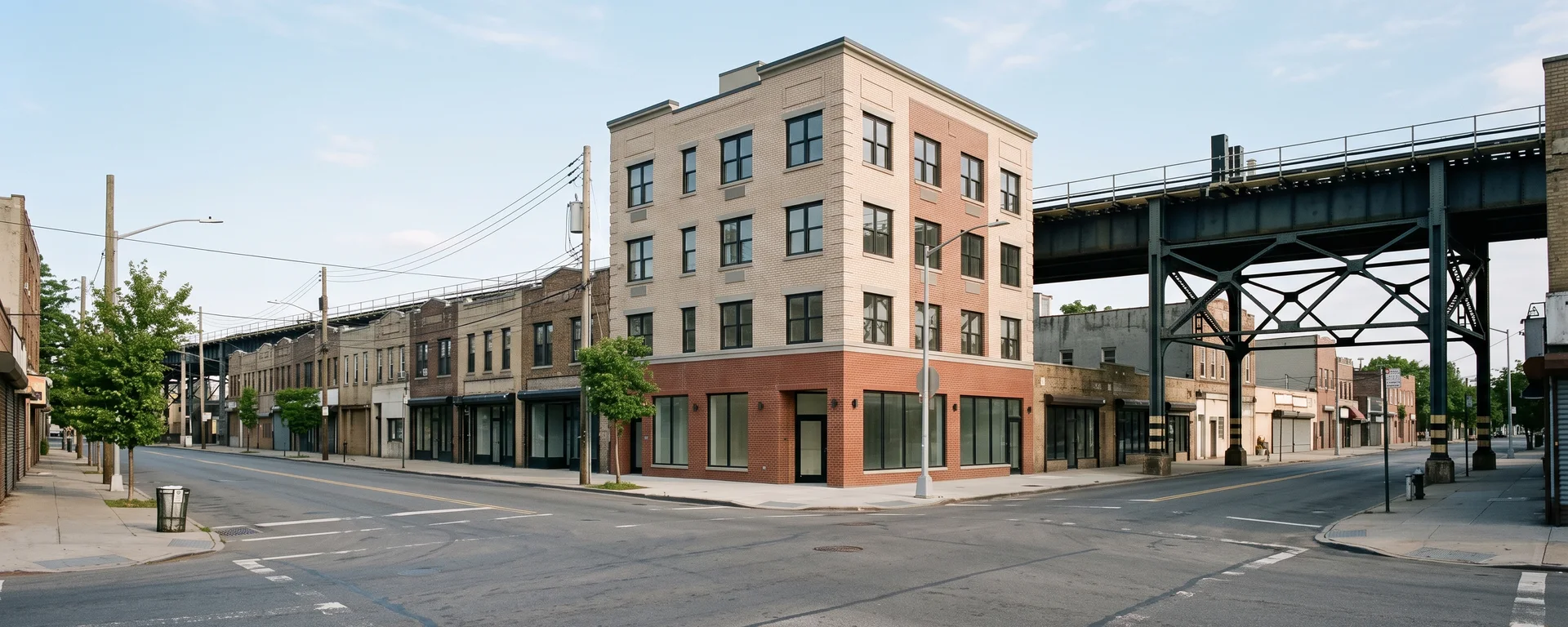
City of Yes is three NYC zoning initiatives in four text amendments, adopted 2023 to 2024: each one's changes, its geography and the governing text.
Updated September 2026. City of Yes is three zoning initiatives carried by four text amendments, all adopted and all in effect: Carbon Neutrality on December 6, 2023, Economic Opportunity on June 6, 2024 with its manufacturing district companion the same day, Housing Opportunity on December 5, 2024. The third is the one people mean. One deadline is still live: a new construction project relying on the pre-City of Yes Inclusionary Housing text has to record its regulatory agreement on or before December 5, 2026. The preservation path closed on December 5, 2025. Building the affordable units City of Yes generates? Marketing agent services is the piece MGNY runs.
City of Yes changed what may be built across all neighborhoods in New York City without changing the zoning designation of any site. Here is what the three amendments did, what the City Council changed before voting, where each piece applies, and which text governs a project already under way.
What is City of Yes, and what did each amendment do?
City of Yes is a set of citywide zoning text amendments written by the Department of City Planning and adopted one at a time by the City Council. A text amendment rewrites rules inside the Zoning Resolution, and DCP says Housing Opportunity “does not change the zoning designation of any site.”
| Amendment | Application number | Adopted | Subject |
|---|---|---|---|
| City of Yes for Carbon Neutrality | N 230113 ZRY | 12/6/2023 | Renewable energy, retrofits, EV charging, water, compost and recycling |
| City of Yes: Zoning for Economic Opportunity | N 240010 ZRY | 6/6/2024 | More store types in more places, clean manufacturing, life sciences, home businesses |
| The same, for manufacturing districts | N 240011 ZRY | 6/6/2024 | The M district companion, same day |
| City of Yes for Housing Opportunity | N 240290 ZRY | 12/5/2024 | Housing rules in every district. The one people mean |
Adoption dates from the Zoning Resolution’s own recently-adopted entries. The rest of this page is about the fourth row.
What did Housing Opportunity change in low-density neighborhoods?
Five things landed in the low-density districts, R1 through R5, and one of them reaches further.
Town Center zoning re-legalized apartments over shops, at “2, 3, or 4 stories of housing above a commercial ground floor, depending on zoning.” It skips isolated single-block commercial overlays and blocks built mostly with one- and two-family homes.
Transit-oriented development re-legalized “3, 4 or 5 stories” near subway and rail stations in R3 through R5. The adopted text is narrow about which lots qualify. In an R1 through R5 district the main path asks for all four of at least 5,000 square feet, a location inside the Greater Transit Zone, frontage on a wide street or the short dimension of a block, and a district other than R1 or R2. Three narrower paths sit alongside it in those districts: a lot inside the Greater Transit Zone holding a building with community facility floor space that existed on December 5, 2024, a lot outside the zone with 5,000 square feet and that same community facility floor space, and an R3-2, R4 without a letter or number suffix, R5 or R5B lot holding qualifying senior housing. The definition adds separate paragraphs for C1, C2 and C4 districts and for M1 paired with R1 through R5.
Accessory dwelling units became legal on one- and two-family properties in every residential district, under tight caps: one per residence, 800 square feet, and the lot must be an owner’s primary residence at initial occupancy. Basement, cellar and backyard units are barred inside the DEP flood risk areas drawn on 2050 rainfall and 2080 coastal projections, backyard units again in R1-2A, R2A and R3A beyond the Greater Transit Zone and in any Landmarks-designated historic district. Our guide to ADUs in NYC carries the rest.
Inclusionary housing reached low density for the first time. A building above roughly 50 units “can be 20% larger if the additional homes are permanently affordable to households earning an average of 80% Area Median Income,” which HPD runs as the Affordable Qualifying Residential Site, which applies where a lot takes the qualifying residential site floor area and its maximum residential floor area exceeds 50,000 square feet.
Fifth, the district fixes adjusted floor area ratio, perimeter heights, yards, lot coverage and minimum lot dimensions to “bring more homes into compliance,” with the Council limiting the decrease in frontage and lot area, limiting reductions to side yards and adjusting the lot coverage rules to protect open space.
What changed in medium- and high-density districts, and citywide?
In R6 through R10 the headline is the Universal Affordability Preference. In HPD’s words, UAP “allows buildings in all medium and high-density districts outside of Mandatory Inclusionary Housing areas to add at least 20% more housing, provided the additional homes are permanently income-restricted and affordable to households earning an average of 60% of the Area Median Income (AMI).” The bonus floor area holds those units one for one, in no more than three income bands, none above 100 percent of AMI. UAP replaced Voluntary Inclusionary Housing, which reached 13 percent of these districts where UAP reaches all of them. Albany’s repeal of the floor area ratio cap also let DCP write three districts with ratios above 12, R11 and R11A at 15 and R12 at 18, each requiring Mandatory Inclusionary Housing: DCP says they “will be mapped where they fit best: central neighborhoods with good access to jobs and transit, like Midtown Manhattan.”
More changes run citywide. Parking mandates were rolled back on a three-zone system. Conversions got easier, the text now reaching buildings “existing on December 31, 1990” where the old rules stopped at 1961 or 1977; see office to residential conversion in NYC. Small and shared housing got room, through a lower, standardized dwelling unit factor and the removal of the zoning bar on shared kitchens. Campus infill was unlocked citywide for contextual, height-limited buildings, with recreation space protected, NYCHA campuses excluded and lot coverage limits added by the Council on campus sites smaller than 1.5 acres. In the adopted text the coverage caps sit in Sections 23-361 and 23-362 and bite only where a site uses the height and setback modifications of Section 23-425 or 23-434: 50 percent of a large site, meaning 1.5 acres or more, and 65 percent on other lots of 30,000 square feet or more. And landmark development rights, once transferable only to an adjacent lot, may now travel by certification under Section 75-422 to any lot on the same block or across a street or street intersection from that block, the receiving lot’s floor area capped at 20 percent above what its zoning allows, or 30 percent in commercial and manufacturing districts where the non-residential floor area ratio is 15.0 or greater. Fewer than 15 landmarks sold development rights at all in the previous 50 years, almost all of them in central Manhattan.
| Zone | Area | Residential parking requirement |
|---|---|---|
| Zone 1 | Manhattan Core and Long Island City parking areas, plus the Inner Transit Zone | None |
| Zone 2 | Outer Transit Zone | Significantly reduced |
| Zone 3 | Section 25-241 special provision areas, and everything beyond the Greater Transit Zone | Generally unchanged |
Parking zones as DCP groups them. Exemptions cut across all three: affordable housing, ADUs, houses of worship and qualifying developments of 75 units or fewer carry no requirement in Zones 1 and 2, and in Zone 3 affordable housing gets a reduced one while ADUs, houses of worship and Town Center developments of 75 units or fewer carry none. Shared housing, though, still waits on Council legislation, since City of Yes “only removes the zoning restriction.”
What did the City Council change before it voted?
Quite a lot, and it published its own summary of the modifications. The modifications cleared the Subcommittee on Zoning and Franchises and the Committee on Land Use on November 21, 2024. The Council frames them as three moves: more contextual development on blocks of small homes, more affordable housing reaching lower incomes, and protection for existing tenants and homeowners.
Several of the limits described above are Council modifications rather than parts of DCP’s proposal, and the Council’s own summary records them. Parking is the clearest case: DCP had proposed to “remove all residential parking requirements on new housing, citywide,” and the Council replaced that with the three zones, turning a repeal into a geography, Zone 1 reaching only Manhattan except Inwood, Long Island City and parts of western Queens and Brooklyn. The ADU flood, historic district, single-story, row house, rear yard and owner-occupancy limits are Council additions too, as is the exclusion of every R1 and R2 single-family district from transit-oriented development and the cut in radius around the outermost LIRR and Metro-North stations from half a mile to a quarter mile.
Against those cuts it added affordability. The headline is that the new low-density incentives “make inclusionary zoning citywide for the first time in New York City,” and the incentive programs were pushed down to 40 percent of AMI, “approximately $43,000 for an individual and $62,000 for a family of four.” In UAP that became a requirement: 20 percent of the UAP units at 40 percent of AMI on any site with 10,000 square feet or more of UAP floor area, which HPD administers as 20 percent of the affordable floor area, with maximum heights cut 10 feet in R8B and on narrow streets in R6 and R7-1. Elsewhere rear yard obstructions came back from 50 to 33 percent, campus sites under 1.5 acres picked up lot coverage limits, a landmark transfer raising a receiving site’s height by more than 25 percent kept its special permit, and for new apartment buildings the dwelling unit factor was eliminated in Manhattan below 96th Street and in downtown Brooklyn but standardized at 680 square feet elsewhere, with existing apartment buildings left on the current rules. Companion bills passed the same day, among them Intro 1128-A on ADU design and Intro 1127-A on basement legalization.
How much housing does the City say City of Yes creates?
DCP’s post-adoption deck says Housing Opportunity “Enables the creation of 82,000 new homes over the next 15 years across all 5 boroughs” and “Invests $5 billion in infrastructure and housing.” The Council states the same figure, “estimated to create over 82,000 housing units over 15 years,” and calls the $5 billion City and State commitments to its City for All housing plan. Set that against the problem DCP describes: an apartment vacancy rate of “1.41% – the lowest since 1968,” and ten community districts producing as much housing in 2023 as the other 49 combined. 82,000 homes across 15 years is under 5,500 a year citywide, and it is the City’s own estimate.
Where does City of Yes apply, and which text governs your project?
It is citywide, and the pieces apply on different geographies. Town Center follows commercial overlays, transit-oriented development follows station radii and lot geometry, parking follows the three zones, ADU limits follow flood maps and historic districts. DCP publishes an applicability map deck per community district: 51 pages wrapped around that district’s own drawings of TOD and Town Center applicability, the parking zone and maximum heights. Three live in September 2026 are Manhattan Community District 1, Queens Community District 13 and Staten Island Community District 3. DCP’s own caveat is worth repeating, that a deck “is not meant to serve as a substitute for the actual regulations.”
Then the harder question, the one about which text a project already in motion has to follow. A generating site subject to a regulatory agreement on December 5, 2024 stays with the old Sections 23-154 and 23-90 outright. Everything else vests on a sequence of dates, and two further paths sit outside that sequence.
| Project type | Deadline | Step that must be finished by then |
|---|---|---|
| Any generating site | December 5, 2024 | A regulatory agreement already in place, which keeps the old text outright |
| New construction | December 5, 2024 | New construction affordable housing application filed with the Department of Buildings |
| New construction | December 5, 2025 | DOB approval of a foundation, new building or alteration, on a complete zoning analysis showing compliance with the rules as they stood before December 5, 2024 |
| New construction | December 5, 2026 | Regulatory agreement executed and recorded against the site |
| Preservation | December 5, 2024 | Preservation affordable housing application filed with HPD |
| Preservation | December 5, 2025 | Regulatory agreement executed and recorded against the site |
| Large-scale general or residential development | December 5, 2024 | CPC certification of the special permit, which also covers a generating site feeding a large-scale general development |
| Single-parcel declaration under Section 62-362 | Before December 5, 2024 | Declaration made, which keeps Sections 62-352 and 62-354 as they stood |
Inclusionary Housing vesting dates, HPD. Miss a step and the project files under the new text, ZR Section 27-00, on HPD’s April 2025 or later forms, with stacking charts updated August 2026. Voluntary Inclusionary Housing survives only for projects that vested.
Why does Staten Island come up in City of Yes searches?
Because the borough sits differently in the Zoning Resolution, and did so long before City of Yes was drafted. The adopted definition names the whole Borough of Staten Island as a designated area, alongside exactly one other place, Community District 10 in the Bronx. Inside those two areas the lower density growth management area is every R1, R2, R3, R4A, R4-1 and C3A district, plus any lot whose buildings are reached by a private road in an R1 through R5 or C3A district. In Staten Island alone the designation reaches further, picking up any C1, C2 or C4 district as well. It still carries its own parking rules. Section 25-622 governs where a parking space may sit on a zoning lot with residences in R1, R2, R3, R4-1 and R4A districts inside these areas, and Section 25-632 governs driveways and curb cuts on lots with residences across all of them. Quantity rules survive too, for community facility uses rather than homes, among them the 1 per 1,000 square feet child care rate in Section 25-311. The old higher ratios are gone. Before City of Yes these districts required 1.5 spaces per dwelling unit, and Staten Island required two per single-family residence and three per two-family residence. The adopted Section 25-232 replaced all of it with one space per standard dwelling unit beyond the Greater Transit Zone in R1, R2, R3A, R3-1, R3X, R4-1, R4B, R4A and R5A, half a space for an income-restricted unit and none for an ADU, waived outright on a qualifying residential site of 75 dwelling units or fewer.
Beyond that, and one more borough-wide rule in Section 25-62 requiring community facility parking spaces to sit in a stall reached from a travel aisle, the record does not single the borough out. Neither the Council’s modifications summary nor its press release on the vote mentions Staten Island once, and DCP goes no further than “what works to create new housing in Midtown Manhattan won’t work in Eastern Queens or the South Shore of Staten Island.” The honest answer for any given block is on its community district map.
What does City of Yes mean for an owner or a developer?
It means the envelope question and the tax question moved at different times and have to be answered together. City of Yes changed what may be built. It did not change what the building pays.
On the zoning side the work belongs to an architect and to zoning counsel: whether a lot is a qualifying residential site, its parking zone, whether a flood map bars an ADU, the UAP floor area a district yields. MGNY does not perform that analysis and does not file at the Department of Buildings.
On the affordable and tax side the work is ours. Every UAP, MIH or AQRS unit City of Yes generates has to be marketed through a regulated process, with HPD’s completion notice gating the certificate of occupancy, and where the units go through a City lottery that runs on NYC Housing Connect under the HPD and HDC Marketing Handbook. MGNY is a prequalified HPD marketing agent, runs HPD lottery management and stays on for the monitoring. The tax exemption a deal is underwritten around is a separate filing: 485-x for new multiple dwellings and homeownership projects of six or more units, 467-m for a conversion of six or more units that commenced after December 31, 2022 and on or before June 30, 2031, and 421-a for anything vested under the earlier program. DCP said as much itself, that UAP “was designed to work together with a tax benefit program like the recently created 485-x program.” A workable order: the architect tests the envelope, counsel confirms which text governs, HPD’s Inclusionary Housing application follows at $100 plus $100 for the construction sign and $1,100 per affordable unit, and marketing begins at least six months ahead of the first unit’s occupancy.
City of Yes questions, answered
What does City of Yes actually change?
The text of the Zoning Resolution, not the zoning map. Housing Opportunity changed “residential height, density, parking requirements, affordability, urban design, and other aspects within city zoning regulations,” leaving district designations alone.
When did City of Yes pass?
On three dates: Carbon Neutrality on December 6, 2023, Economic Opportunity on June 6, 2024 with its manufacturing district companion the same day, and Housing Opportunity on December 5, 2024.
Is there a City of Yes zoning map?
Not a single citywide City of Yes map from DCP. DCP publishes an applicability deck per community district holding that district’s TOD, Town Center, parking zone and height drawings, and points readers at ZoLa for the transit zones.
Does City of Yes eliminate parking requirements?
Only in Zone 1: Manhattan except Inwood, Long Island City and parts of western Queens and Brooklyn. Zone 2 is significantly reduced, Zone 3 keeps most requirements, and ADUs and houses of worship are exempt in any zone, while affordable housing is exempt in Zones 1 and 2 and reduced in Zone 3.
Does City of Yes allow ADUs everywhere?
On one- and two-family properties in every residential district, under real limits: one unit, 800 square feet, owner occupancy, no basement, cellar or backyard unit in the mapped flood risk areas, and no backyard unit in a historic district or in R1-2A, R2A and R3A beyond the Greater Transit Zone.
How does City of Yes affect a 485-x or MIH project?
City of Yes supplies the zoning bonus and the affordability requirement; 485-x supplies the tax exemption. They stack, and DCP designed UAP with that in mind. Both run through HPD, each with its own filing sequence.
What does it cost to ask MGNY?
Nothing. A real person answers at (212) 343-1111, right away, and the consultation is free. You engage us only if you want the work handled for you. MGNY has worked NYC property tax since 2008, with $50M+ in tax refunds secured for owners, 900+ developments with tax abatements secured and $30B+ represented in appeals.
City of Yes floor area arrives with permanently affordable units attached, and those units have to be marketed, leased and monitored.
MGNY runs that half: the marketing, the lottery, the lease-up and the monitoring, plus the 485-x benefit application where that program applies. Call (212) 343-1111 and we will tell you which pieces are ours and which belong to your architect.
Sources: the Zoning Resolution’s recently-adopted entries for Carbon Neutrality, Economic Opportunity and Housing Opportunity, with the adopted definitions, conversion, parking and affordable housing chapters and the landmark transfer Section 75-422; DCP’s per-district applicability decks, FAQ and landmarked buildings sheet and CPC-modified text of N 240290 ZRY; the City Council’s press release on the December 5, 2024 vote and its own summary of modifications; and HPD’s Inclusionary Housing page with its UAP fact sheet of April 2025, and the HPD and HDC Marketing Handbook. All read September 6, 2026. DCP’s web pages now serve a JavaScript shell that returns no text to a server-side fetch, so every DCP fact here comes from a DCP PDF instead. MGNY Consulting is a private consulting firm and is not affiliated with the NYC Department of City Planning, the NYC Department of Housing Preservation and Development or the NYC Department of Finance.
Get our updates first on Google. Deadlines move: a new construction project relying on the pre-City of Yes Inclusionary Housing text has to record its regulatory agreement on or before December 5, 2026, the preservation path closed on December 5, 2025, and HPD reissued the MIH and UAP stacking charts in August 2026. Tap the button and Google adds MGNY Consulting to your preferred sources, so our coverage surfaces first in your results. No signup and no email, and one tap undoes it.